seminars
07
Oct
2026
Mathematics
KӒHLER-EINSTEIN METRICS WITH LARGE SYMMETRY - LECTURE 4
Physical
Back
What is time, exactly, and how can we keep track of it? As strange as it may seem, physicists are still looking for precise answers to these questions. In quantum mechanics, time plays a different role from other quantities such as position, energy and momentum, as it is not an observable that can be measured directly. Moreover, the equations of quantum mechanics do not single out a preferred direction of time. How can one then rely on the laws of quantum mechanics to keep track of time?
An international collaboration including ICTP postdoctoral fellow Ludmila Viotti and ICTP senior research scientist Rosario Fazio might have just found a route to answering this question by proposing a protocol to build a high-precision clock that exploits the properties of quantum mechanics. In an article published in Physical Review Letters, they suggest that the properties of time crystals, a new quantum phase of matter recently predicted and experimentally explored, could be used for timekeeping.
“Our aim was to build a framework in quantum mechanics that could help us tell that one instant is different from another,” explains Viotti. Similarly to how atoms and molecules in crystals can occupy only a discrete set of positions, in a periodic structure, time crystals are systems characterized by periodicity in time, like sophisticated quantum pendulums. This property makes them ideal candidates for quantum clocks.
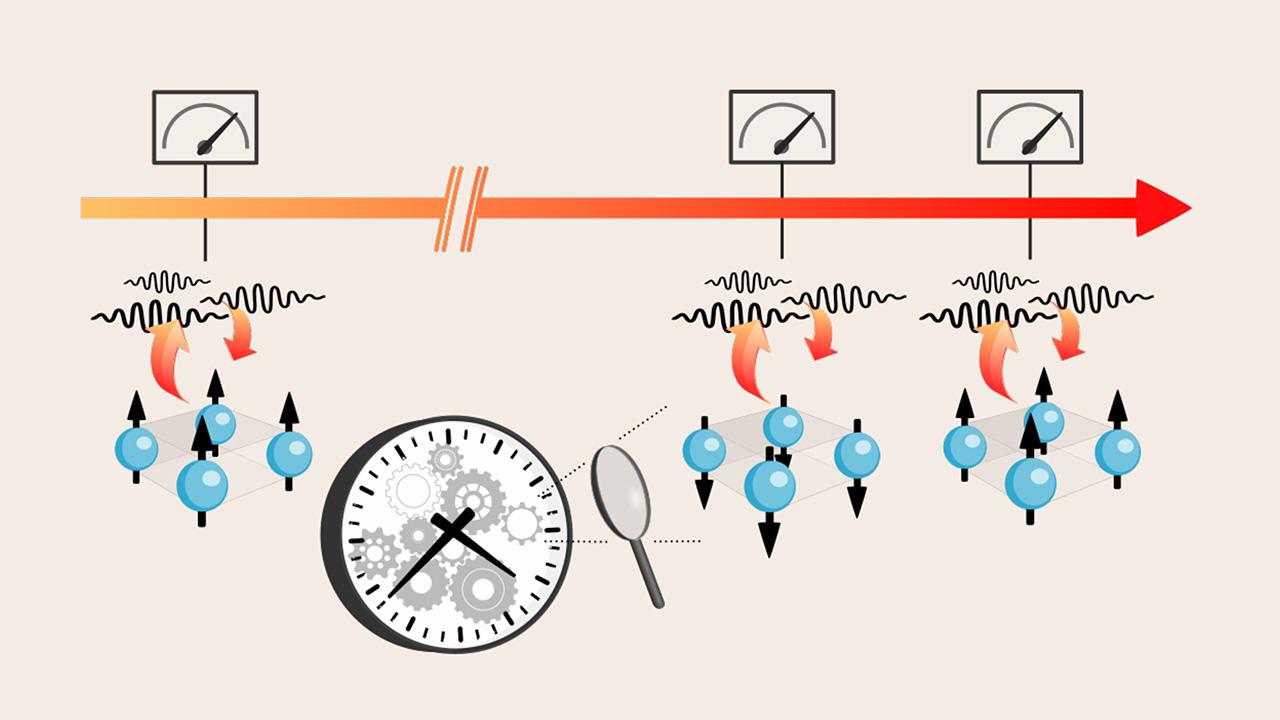
The specific model considered by Viotti and her collaborators for a time crystal consists of three main components: a set of spin ½ particles, each behaving like a simple two-state system, interacting with a thermal bath. The thermal bath is also coupled to an external coherent mode. A few years ago, a group of scientists including ICTP researchers Fazio and Marcello Dalmonte showed that in the idealized limit of infinitely many spins, such a system undergoes a phase transition into a time crystalline phase.
Because working with very large numbers of particles in the lab is challenging, Viotti and collaborators were determined to find a way to use the properties of time crystals even for systems with a finite number of spins. “To do that, we added to our model a continuous monitoring setup, where we monitor the environment by counting photons absorbed and emitted by it, rather than by the spins themselves. That allowed us to exploit finite-size reminiscent effects of the time-crystallinity,” she explains.
“We fixed a threshold for the number of emissions and absorptions happening in the environment, and found that the waiting time between successive threshold crossings is regular enough to define the ticks of a clock,” Viotti continues. In other words, the team was able to propose a protocol to access an underlying time-periodicity in a many-body quantum system, and to show that this can be used to measure the passing of time. They also characterized the performance of their clock, thus shedding light on the fundamental nature of quantum matter.
The work of Viotti and her collaborators tells us more about the fundamental relation between time and matter. The quantum time crystal clocks they have described are still only a theoretical proposal, but could pave the way for extremely precise clocks that, unlike the expensive and energy consuming optical quantum clocks currently only available in a few laboratories worldwide, could be portable and less energy-intensive, and highly accurate.
Full paper:
L. Viotti, M. Huber, R. Fazio, and G. Manzano, Quantum Time Crystal Clock and Its Performance, Phys. Rev. Lett. 136, 110401 (2026), https://doi.org/10.1103/dj21-gmd