scientific activity
19
Oct
2026
06
Nov
2026
Earth System Physics
2026 ACCLIMATISE Huddle | (smr 4330)
Physical

Back
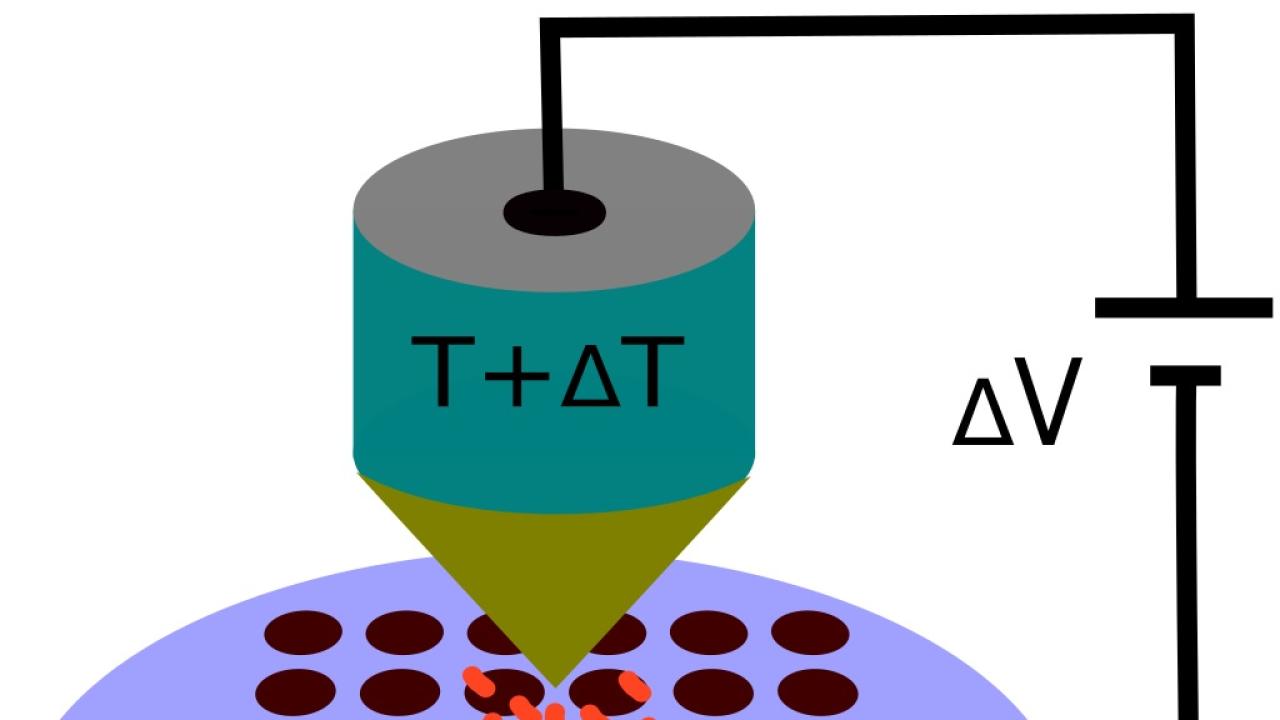
Probing the charge- and heat-conducting properties of materials is a widely used method for understanding the microscopic principles that govern physical systems.
In a paper recently published in Physical Review Letters, Andrei Pavlov (a former CMSP postdoctoral fellow) and Mikhail Kiselev propose a unified theory of noise for weakly coupled systems. This theory applies to setups such as typical thermoelectric devices or scanning tunneling microscopes.
Transport experiments usually involve measuring currents under an applied bias (voltage or temperature difference) or measuring current noise (fluctuations) under the same bias. For nearly two centuries, the celebrated Wiedemann-Franz law has established that charge and heat currents in normal metals are directly related. This relationship reveals key microscopic properties, such as the fact that electrons transport both heat and charge.
However, despite the long history of transport studies, the connection between different types of noise has remained unclear. This new study demonstrates that the Wiedemann-Franz law is actually just one of five laws connecting different current and noise observables through a set of universal constants. These constants serve as unique "fingerprints" that identify the underlying microscopic theory governing the system's mesoscopic behavior.
Reference: A. Pavlov and M. Kiselev, Phys. Rev. Lett. 136, 046301 (2026). https://journals.aps.org/prl/abstract/10.1103/h5ty-45rf