
seminars
07
Sep
2026
High Energy, Cosmology and Astroparticle Physics
HECAP Seminar by Oriol Pujolas - Title TBA
Hybrid
Back
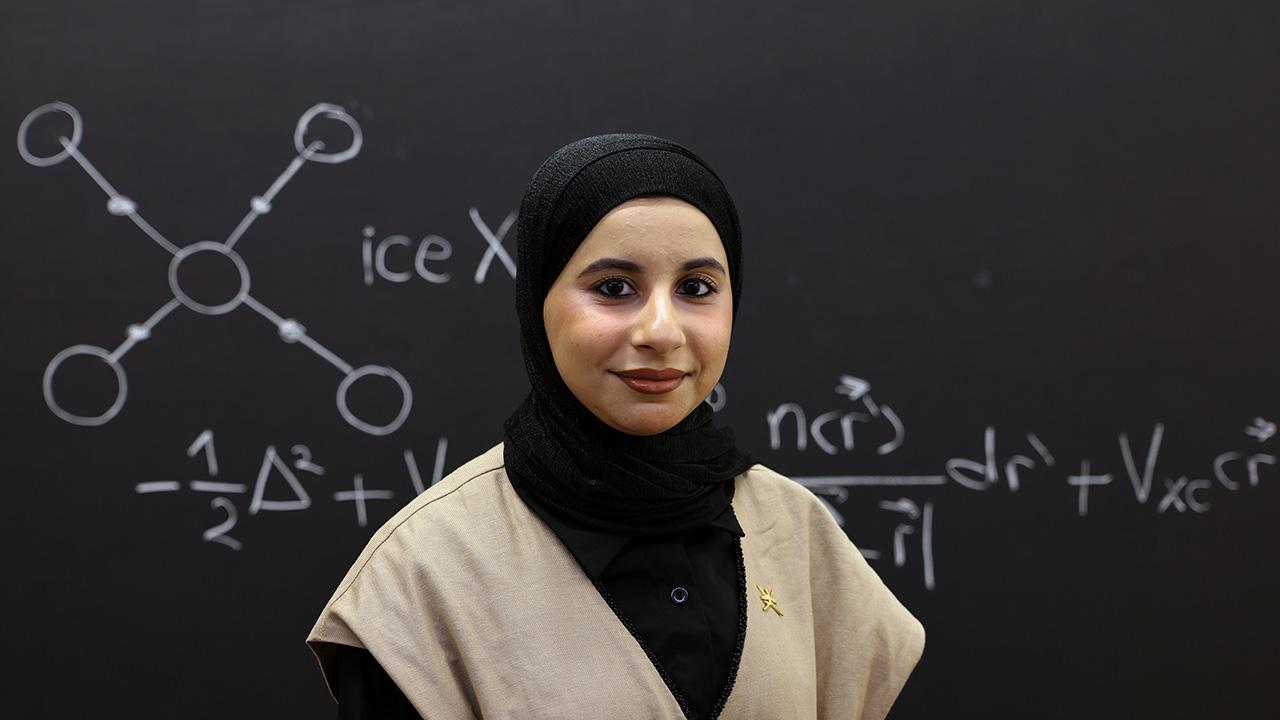
Manar Al Kharusi’s first encounter with physics was in high school. When she was introduced to Newton’s laws, she marvelled at the fact that one could predict a particle’s full trajectory just by knowing the forces at play. Later, it fascinated her that Einstein’s most famous equation, E=mc2, can tell us how much energy we can get from a spoon of sugar. “That is when I decided to study physics at university,” she says.
Motivated as she was, however, her first course in general physics at Sultan Qaboos University in Oman, her home country, was a challenge. Because of the Covid-19 pandemic, the lectures only took place online and they were in English, a language that she had not been exposed to much in school. “Moreover, the course was based on advanced calculus, of which I had only basic knowledge,” Al Kharusi explains, adding, “It was a disaster and I started doubting that physics was a good choice.” But things quickly got better and her results improved already from the second semester.
During her five-year degree, Al Kharusi explored different aspects of physics: she majored in general physics, with a minor in medical physics. She also worked as a lab technician assistant, which exposed her to experimental work, and as a teaching assistant, helping professors prepare their tutorials and mark the exams. “I realised that I am not a lab person,” she says, adding, “And because I am shy and it was difficult for me to interact with the students, teaching did not feel right either.”
These experiences convinced Al Kharusi that theoretical physics was what she wanted to do. In her final project, she worked on density functional theory, or DFT, a computational method used to study the electronic structure of atoms and molecules, and ultimately of materials. Being involved in this research project gave her the feeling that she had found her path. “I obtained interesting results, which led to a paper,” she recounts, adding, “What made the whole experience so positive is also that, after I graduated, my supervisor asked me if I could work with him as an assistant researcher to study certain polymers. I told myself that this was my place.”
By the time she finished university, Al Kharusi already knew that she wanted to enrol in the ICTP Postgraduate Diploma programme. The first time she heard about it was from one of her professors, who had spoken enthusiastically about a recent visit to ICTP. “I still have a note from that discussion in my phone. It is from 2023,” she says, adding, “I made a mental note that when I graduated, I would apply. No one would have made me change my mind. Although my family was worried about letting me study abroad, they supported me with all their hearts. Now, seeing how far I’ve come, they are so proud of me. Their support means everything to me, and I’m so grateful to have them by my side.”
The Diploma programme in Condensed Matter and Statistical Physics gave Al Kharusi some of the theoretical foundation that she did not get from her bachelor’s degree, especially in statistical and quantum mechanics. “When I applied DFT back in Oman, I used it without knowing the basic theory behind it. Now I have solid foundations in electronic structure and density functional theory,” she says.
In her final project, Al Kharusi applied DFT to study ice at extreme pressure. In particular, she investigated if and how a new crystalline structure emerges at pressures above 200 GPa, which experiments on ice have only recently been able to access. “I chose this project to learn more about electronic structure and the computational methods used to study it,” she explains.
Although she has not yet decided whether to pursue a master’s or a PhD, Al Kharusi is determined to continue working in electronic structure and computational condensed matter physics. Even if that means that she might need to stay abroad for a little bit longer, she also knows that she would like to go back to Oman and work there one day. “I am very connected with my country and I want to bring something back,” she says.