seminars
06
Oct
2026
High Energy, Cosmology and Astroparticle Physics
HECAP Seminar by Martin Lagares - Towards Integrability Beyond Flat Sp...
Physical
Back
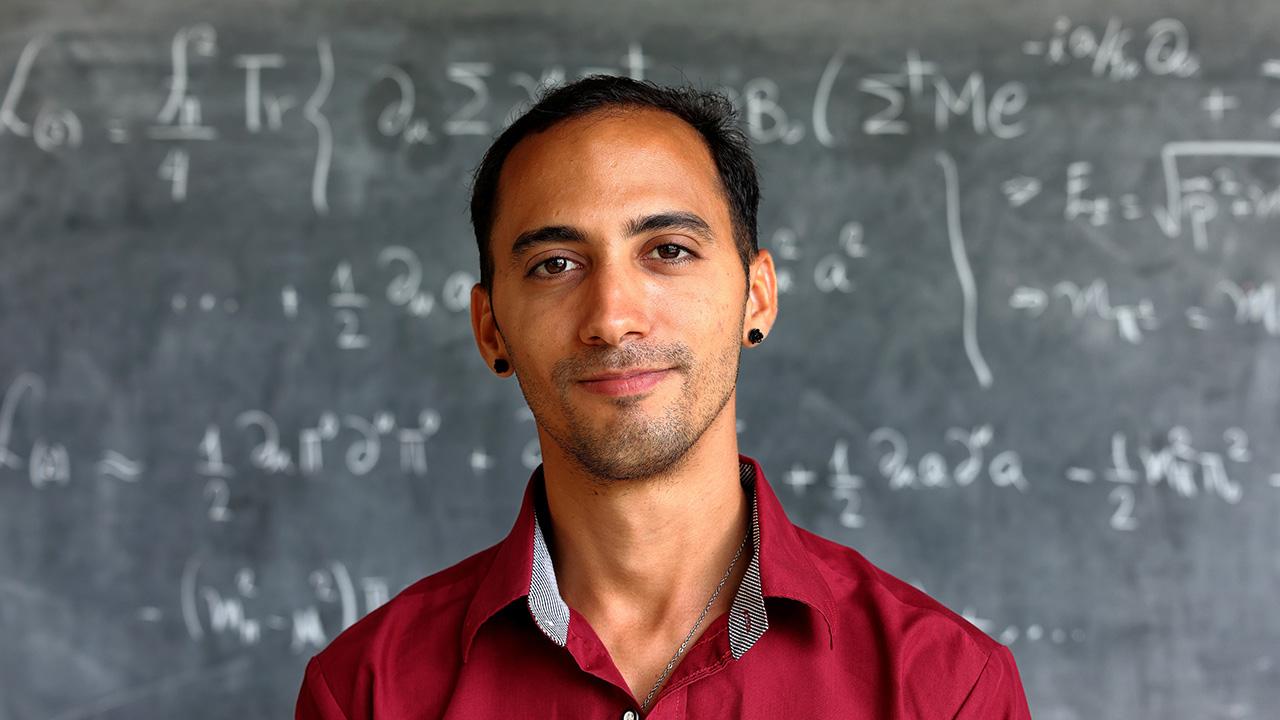
Born and raised in Cuba, Adriel Rodriguez has always had a natural inclination for science. “When I was a child, I wanted to become a paleontologist,” he says. Later, once he started studying physics in school, his interests veered towards exact sciences. In high school, he started participating in national physics contests and because his results were good, he was given the possibility to enter university without undertaking the selection exam. “A degree in physics became the clearest path ahead,” he says.
At the University of Havana, physics undergraduate students are required to join a research group already when they are in their second year, in addition to taking courses and passing exams. But because he had done so well in high school, Rodriguez decided to start working side by side with researchers already in his first year. Inspired by the lectures of an engaging professor, he chose astrophysics and joined a group at the Institute of Cybernetics, Mathematics and Physics, in Havana. “This system gave me many opportunities. If you work hard as a student in Cuba, there are many resources, both inside and outside university, that can help you do well.”
And work hard he did. When the Covid-19 pandemic hit in 2020, the situation at Rodriguez’s university became complicated, but the more complex the situation, the more efforts he put into his studies. “Physics was what I wanted to do with my life, and I knew it was worth running the extra mile,” he says. His efforts paid off. “By the time I reached the fifth and final year of university, I had already gathered a lot of research experience and had a strong thesis project,” he explains.
During his time in Cuba, Rodriguez had the opportunity to attend summer schools in Germany and Brazil. Discussions with other researchers helped him clarify his plans for the future and envision his next step at ICTP. “Although it might have been possible to enrol in a PhD programme right after graduation, I decided to build a more solid and broader background in theoretical physics before I specialised in astrophysics. The ICTP Diploma Programme seemed perfect for that,” he states.
Rodriguez arrived at ICTP in September 2025, after spending one year as an assistant researcher in Havana, working with the same group that he had been part of since his first year at university. Having specialised very early in astrophysics, the many courses on particle physics and quantum field theory at ICTP were unfamiliar ground. “The beginning was tough. I felt totally lost and had the impression that all the other students could understand what I didn’t,” he recounts, adding, “Then winter came, the first winter of my life, and that made things even worse.”
Rodriguez realises now that many among his fellow students must have felt the same. “We all come from different trajectories, and have different strengths. Of course, we feel left behind in some courses and are stronger in others,” he reflects. With time, however, he got into the rhythm of the programme. As he puts it, “I was less in a ‘reacting mode’ and was rather moving forward with the programme.” With that also came more enjoyment, less stress, and the ability to fully take advantage of the opportunity to learn.
For his final project, Rodiguez decided to work on axions, hypothetical particles that have been identified by physicists as strong candidates for the elementary constituents of dark matter—matter whose presence in the universe we only know because of its gravitational effects, but that is completely invisible to us and whose fundamental constituents we still don’t know. Rodriguez’s interest in these particles is motivated by the research problem that he will be working on during his PhD at the University of Hamburg, Germany. “I will be exploring Beyond Standard Model Physics in neutron stars mergers,” he says. Essentially, he will be looking at how the gravitational waves generated by merging neutron stars are affected by the presence of axions. “Dark Matter is more present where there is a strong gravitational field, like close to neutron stars. By comparing the gravitational signal we see in our simulations with actual observations, we will be able to tell how they differ and will find out more about dark matter,” he explains. “I will do what I always dreamt of doing: programming and running simulations in big computers to get images of stars crushing. And I will do that at an observatory in Germany,” he adds enthusiastic.
Rodriguez left Trieste to Hamburg at the end of July, but before going he had a final message for the next cohort of diploma students: “Don’t be frightened by the intensity of the programme, and don’t compare yourselves to each other. Take it with patience and calm, try to learn every day a bit more, without rushing into a rhythm that is too difficult to follow. Focus on learning, because there is a lot to learn here and you will get a very robust preparation by studying and doing your homework. And always ask questions.