
seminars
02
Oct
2026
26
Feb
2027
Earth System Physics
Current Weather - Fridays 14:30 CET
Hybrid
Back
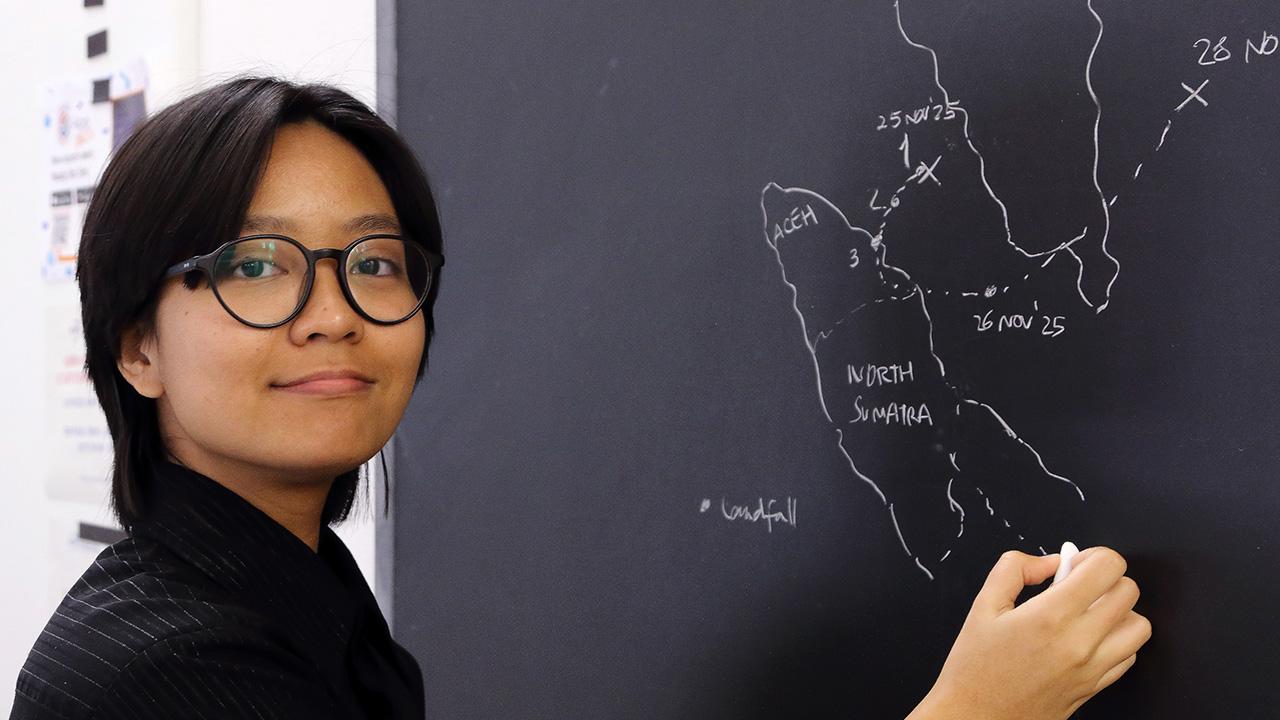
As they were growing up in Indonesia, Nathasya Christien struggled to see that their ease with numbers and equations could take them right where they wanted to be. Their wish was always to help tackle environmental challenges, but for a long time they did not see how mathematics could play a role. Now they have found their path in climate science and are completing the ICTP Postgraduate Diploma Programme in the Earth System Physics section with the dream to pursue a PhD that will let them support their home country in its struggle against environmental hazards.
Christien began to see mathematics as a versatile tool applicable far beyond the classroom thanks to a mathematics podcast during high school. “I realised then that there were many possibilities for me,” they say. As a nature lover, when the time came to choose their undergraduate research project, Christien decided to apply their knowledge of game theory to a problem that had recently caught their interest, that of transboundary pollution. “Around that time, Jakarta was announced to be the most polluted city in the world. Surprisingly, that was linked to emissions taking place outside the city and coming from far-away coal-fired power plants. It struck me to see that pollution is more complex than one would imagine and that it is not enough to tackle it locally,” they explain.
That was only Christien’s first jump into the type of problems that they dreamt of working on. After graduating, they decided to take some time off university to work for an engineering firm in Jakarta. “The company designs infrastructures that are resilient to climate change and my role was to analyse climate data on extreme events in Indonesia, such as extreme rainfall, tidal highs, and to use climate models to make predictions,” they explain. “That was my first exposure to climate-risk analysis and big climate and meteorological data. From that experience I finally realised that I had found my path,” they add.
The idea to join the ICTP Postgraduate Diploma Programme came right at that time. As they explored climate-science research and the work of the UN’s Intergovernmental Panel on Climate Change, they discovered ICTP's strength in Earth system science and decided to apply to the Diploma Programme. “This seemed like a good fit for me,” they explain.
The first months at ICTP were stressful. Christien was worried that their background in mathematics could be a disadvantage in an applied physics programme, but was happy to see that the other students came from very diverse backgrounds and that the professors had tailored their lectures to make sure that no one was left behind. “This diversity ended up being a real advantage, because we could rely on one another’s different backgrounds and expertise,” they say.
Now, near the end of their Diploma studies, Christien is working on their final project on extreme event attribution, a field that aims to quantify the role played by climate change in extreme events, as opposed to natural climate variations. The framework relies heavily on statistical analysis and climate-model simulations, allowing researchers to estimate how human-driven climate change has influenced specific extreme events. Once again, they chose to focus on Indonesia. “I am applying extreme event attribution to a deadly rainfall and flooding that happened in the Indonesian island of Sumatra last November, causing thousands of victims,” they explain. “We use models to compare the actual 2025 storm with a 'what-if' scenario: how would the same event have behaved in a cooler world, before human-caused warming began?” Analyses from other research groups suggest that climate change played a big role. “These analyses clearly quantify the damage caused by climate change, and they can help us convey a clear message to the general public, and help governments take informed decisions,” they continue.
As they look back at their year at ICTP, Christien reflects on how important it has been for them to receive a training not only on climate science but also on aspects of solid earth physics, and highlights the impact that the classes of late ICTP Senior Research Scientist Karim Aoudia had on their thinking. “Prof. Karim really made me realise that if I want to contribute to mitigating environmental risks in Indonesia, focusing on climate is not enough. There are also problems such as landslides and earthquakes, that in turn can cause tsunamis. All these aspects go hand in hand,” they explain, adding, “For this reason I really hope that the solid-Earth part of the ESP section at ICTP will live on, even after the passing of Prof. Karim.”
With the graduation ceremony approaching, Christien is making plans for their future. Their goal is to do a PhD on climate science to address problems that affect Indonesia. “I don’t think I could study there, but I hope that, even if I will be in another country, I will be given the freedom to work on problems that I deeply care about,” they conclude.