scientific activity
08
Aug
2026
03
Oct
2026
PWF Indonesia: School on Marine Physics in Papua
Online
Back
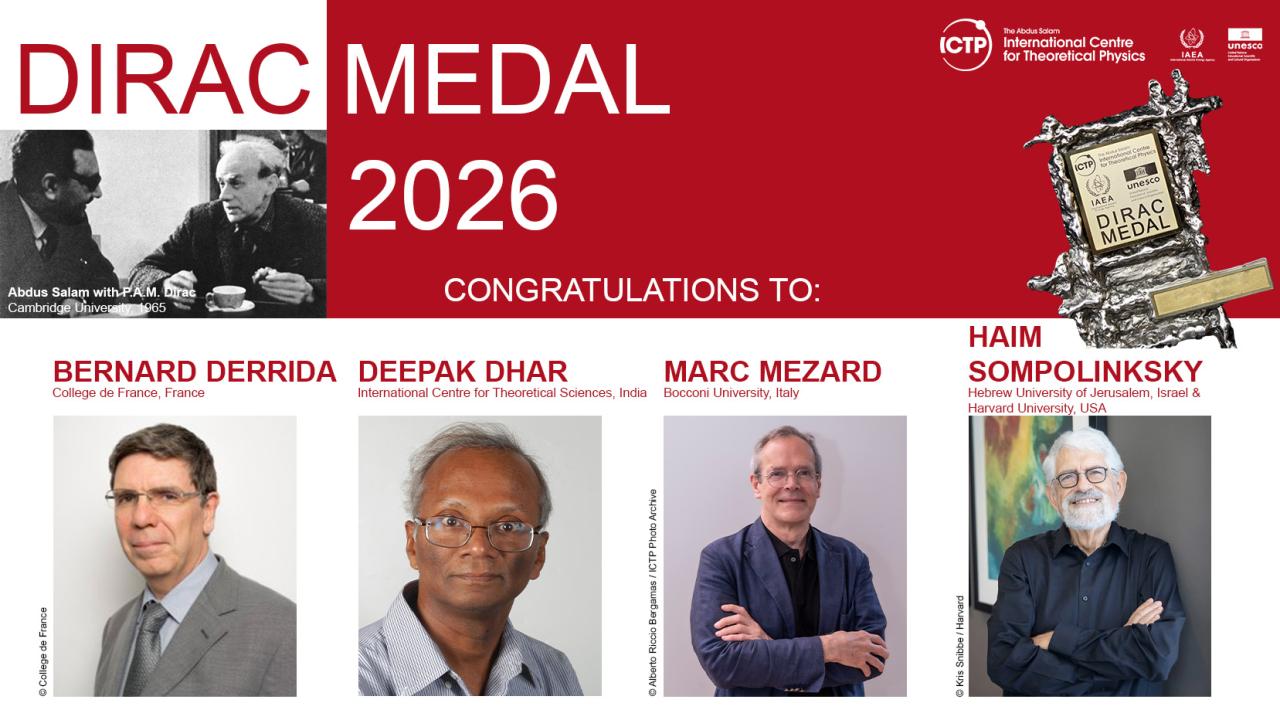
ICTP has awarded its 2026 Dirac Medal to four physicists who have made important contributions to statistical mechanics, a framework used by physicists to describe the collective behaviour of systems with many constituents, and have used it to explore far-ranging concepts in theoretical physics with implications for real-world advancements, from the study of biological systems to that of financial markets and to artificial intelligence.
The Medal citation reads: "For their pioneering contributions to equilibrium statistical mechanics and for extending its concepts and methods into non-equilibrium statistical mechanics, optimization problems, theoretical neuroscience, and, finally, artificial intelligence".
The four winners are:
“The work of the 2026 Dirac Medallists has contributed to establishing theoretical physics, and particularly statistical mechanics, as a powerful framework to tackle a very broad range of questions that go far beyond its traditional domain of interest to encompass biology, computer science and artificial intelligence,” commented ICTP Director Atish Dabholkar who chairs the prize committee. “I am particularly happy that this year’s Medal recognises a research field that has had a long tradition here at ICTP, rooted in part in the work of former ICTP Director Miguel Virasoro, and I warmly congratulate the four winners.”
ICTP Research Scientist Jean Barbier explains what statistical mechanics is and introduces us to the ideas behind the contributions of this year's medallists in this video:
The 2026 Dirac Medallists contributed to understanding different aspects of complex systems using statistical mechanics, with far-ranging applications.
Bernard Derrida developed mathematical models that explain how collective behaviour arises in complex disordered systems. For example, through his Random Energy Model, he was able to show that systems of many constituents can sometimes become dominated by a small number of favourable configurations. Although the model was developed for spin glasses, which originally described disordered magnetic alloys, its ideas have influenced fields ranging from optimisation and neural networks to artificial intelligence.
Deepak Dhar showed how simple interactions can lead to complex and sometimes unpredictable behaviour in large systems. Through his pioneering work on the sandpile model, for example, he described a familiar phenomenon: as grains are added to a sandpile, most result in no change or only small avalanches, while occasionally a single grain can cause a much larger collapse. The theory shows that the sandpile, like many other complex systems, spontaneously places itself in a critical regime where small effects can sometimes trigger large abrupt events and has been used to model systems as apparently different as earthquakes, traffic jams and fluctuations in financial markets.
Marc Mézard helped explain how disordered systems with a high degree of frustration emerging from many competing possibilities behave. One of his most important contributions is the cavity method, developed together with Giorgio Parisi and Miguel Virasoro, which provides a powerful and intuitive framework to describe a broad range of disordered systems, and yields practical algorithms to find their favourable configurations. These algorithms and theoretical ideas are applied in computer science, communication, optimisation, and, more recently, artificial intelligence.
Haim Sompolinsky has used statistical mechanics to understand the behaviour of neural circuits, memory and the brain, and pioneered the field of theoretical and computational neuroscience. While his first contributions regarded the study of spin glasses, early in his career he solved the Hopfield model, a simple mathematical model of memory. He used it to develop a statistical mechanical description of neural networks, which constitutes one of the first rigorous links between statistical physics and brain function, shedding light on the workings of associative memory, the ability of the brain to restore a complete memory from just fragments of it.
Established in 1985, the ICTP Dirac Medal recognises important contributions to the field of theoretical physics. Medallists include leading figures in the discipline, many of whom went on to receive even more important awards, such as the Nobel Prize and the Fields Medal. This year’s selection committee consists of two Nobel laureates and other eminent scientists, all previous medallists, and is chaired by ICTP Director Dabholkar.
Brief Biographies of the Medallists
Bernard Derrida received a PhD at the Institut Laue Langevin, Grenoble and a These d'Etat from Paris XI University. He worked at the French Alternative Energies and Atomic Energy Commission (CEA) in Saclay, before becoming a professor at the Ecole Normale Superieure and University Paris VI. He has been a professor at College de France since 2015. Derrida is an expert in statistical mechanics whose research has focused on dynamical systems, disordered media theory, non-equilibrium physics, and modeling in biology. He has received several awards, including the Boltzmann Medal in 2010 (shared with John Cardy) and the ENS Three Physicists Prize in 2015.
Deepak Dhar received his PhD at the California Institute of Technology. For decades he worked at the Tata Institute for Fundamental Research in Mumbai before joining the Indian Institute of Science Education and Research in 2016. He has been INSA Distinguished Professor at the International Centre for Theoretical Sciences of the Tata Institute of Fundamental Research since 2024. His research focusses on statistical physics and stochastic processes. He received the Padma Bhushan (2023), one of the highest civilian awards of India, as well as the Boltzmann Medal (2022, jointly with John Hopfield), and the Shanti Swarup Bhatnagar Prize (1991).
Marc Mézard obtained a PhD from Ecole Normale Supérieure in Paris. From 2012 and 2022 he was Director of Ecole Normale Supérieure, and then joined Bocconi University as a professor in the newly created department of computational sciences. He has been a member of the ICTP Scientific Council since 2021, and has chaired it since 2024. Mézard’s main field of research is the statistical physics of disordered systems and its use in various branches of science including biology, economics and finance, information theory, computer science, statistics, signal processing and biophysics. In recent years his research has focused on information processing in neural networks, machine learning and deep networks. His distinctions include the 2022 ENS Three Physicists Prize, the 2016 Lars Onsager Prize from the American Physical Society, and the 2009 Humboldt-Gay-Lussac Prize.
Haim Sompolinsky earned his PhD in physics from Bar-Ilan University, Israel and did a postdoc at Harvard University. He was associate professor at Bar-Ilan University before joining the Hebrew University of Jerusalem as professor in 1986. He has been director of Harvard’s Swartz Program in Theoretical Neuroscience and a visiting professor in the Center of Brain Science at Harvard University since 2006. He has introduced methods and concepts of statistical physics to the study of neuronal circuits, memory, learning and neuronal information processing and is widely regarded as one of the leaders of theoretical neuroscience.
Scientific Summaries, Dirac Medallists’ Contributions to Statistical Mechanics
The work of the four winners as described by the 2026 Dirac Medal Selection Committee is summarised as follows:
Bernard Derrida
In spin glasses, Derrida introduced the Random Energy Model (1980), which is the simplest solvable mean-field model. Gross and Mézard showed that its solution is the infinite-p limit of the solution of the p-spin model. With Gardner and collaborators (1987-1988), he made several contributions to the theory of neural networks, in particular he solved an asymmetric version of the Hopfield model. With Spohn, he solved directed polymers on trees (1988), relating the freezing to traveling-wave fronts. In nonequilibrium physics, he (with Evans, Hakim and Pasquier, 1993) obtained a remarkable matrix-product solution of the asymmetric exclusion process that produced the exact steady state of a driven system. His work with Lebowitz and collaborators on large deviations of the current is a basic, solvable example of the off-equilibrium macroscopic fluctuation theory.
Deepak Dhar
Dhar's main result is the exact solution of the Abelian sandpile model, which Bak, Tang, and Wiesenfeld proposed in 1987 as the paradigm of self-organized criticality. Dhar observed that the toppling operators commute, thereby endowing the set of recurrent configurations with an abelian group structure. That one observation made the model solvable: he ties the model to the limit q → 0 of the q-states Potts model. He has done other seminal works in statistical mechanics. In 1983, he obtained exact results for directed lattice animals in linking enumeration to hard-core lattice gases. In 1989, he introduced and solved a directed version of the Abelian sandpile. In more recent years, he has made an important contribution to the Nematic-disordered phase transition.
Marc Mézard
Mézard's early work is at the core of spin glass theory: with Parisi and Virasoro, he developed the cavity method, a probabilistic reformulation of replica symmetry breaking that is often more transparent than the replica trick, and co-wrote the field’s standard reference, Spin Glass Theory and Beyond (1987). With Virasoro, he wrote a seminal paper on the nature of the equations describing the ultrametric organization of pure states and with Gross he showed that the solution to Derrida's Random Energy Model is the infinite-p limit of the solution of the p-spin model. He then carried these ideas into computer science and inference: with Parisi, he mapped combinatorial optimization problems such as matching and the traveling salesman onto disordered systems, and with Parisi and Zecchina, he solved random satisfiability and derived survey propagation (Science, 2002). The same program extends to error-correcting codes, compressed sensing, and, in the book with Montanari, a unified account of information, physics, and computation. His recent focus is on the theory of learning in neural networks. His recent papers on the statistical mechanics analysis of generative models and related backward Langevin equations have attracted great attention in both the physical and computer science communities.
Haim Sompolinsky
Sompolinsky started in spin glass physics: with Zippelius, he formulated the relaxational dynamics of the Sherrington-Kirkpatrick model. With Amit and Gutfreund, he imported statistical mechanics into the field of theoretical neuroscience by solving the Hopfield model. He also computed the storage capacity of many models of attractor neural networks. He extended his dynamic mean-field theory (1988) to many examples of biological and artificial networks. He obtained many relevant results in studying models of brain behavior, e.g., those explaining the irregular firing observed in the cortex. More recently, he obtained very interesting results on the geometry of neural representations and the capacity of object manifolds in deep networks.