seminars
08
Oct
2026
High Energy, Cosmology and Astroparticle Physics
HECAP Seminar by Ignacio Salazar - Renormalization Group Irreversibili...
Hybrid
Back

After doing a master’s degree in high energy physics in his home country, Algeria, Ahmed Salhi wanted to work on something more closely connected to everyday life. He joined the ICTP Postgraduate Diploma Programme in the Earth System Physics section in 2024 to learn about solid Earth physics and seismology—“I needed something that had to do with real data, and that has more immediate applications to society,” he explains.
“North Africa is a very seismically active area, and I grew up hearing stories of the 1980 El Asnam earthquake in Algeria, which had devastating consequences,” he says, adding, “Learning more about how these phenomena originate is very important to help prevent similar disasters.” Salhi’s year as an ICTP Diploma student was supported by the Kuwait Foundation for the Advancement of Sciences (KFAS).
For his final project, Salhi decided to focus on how one can use seismic data to infer Earth’s internal structure and developed tools to do that, working under the supervision of the late ICTP Senior Research Scientist Karim Aoudia and of Keith Priestley of Cambridge University. “The lithosphere includes the Earth’s crust and the upper part of the mantle, and it is where earthquakes happen and propagate,” Salhi explains. “As they travel through Earth, seismic waves encounter discontinuities corresponding to the different layers of the lithosphere. Because we cannot drill and look directly at the Earth’s structure, we can analyse how the seismic signal changes as it propagates as an indirect way to learn more about the different layers of the lithosphere,” he adds.
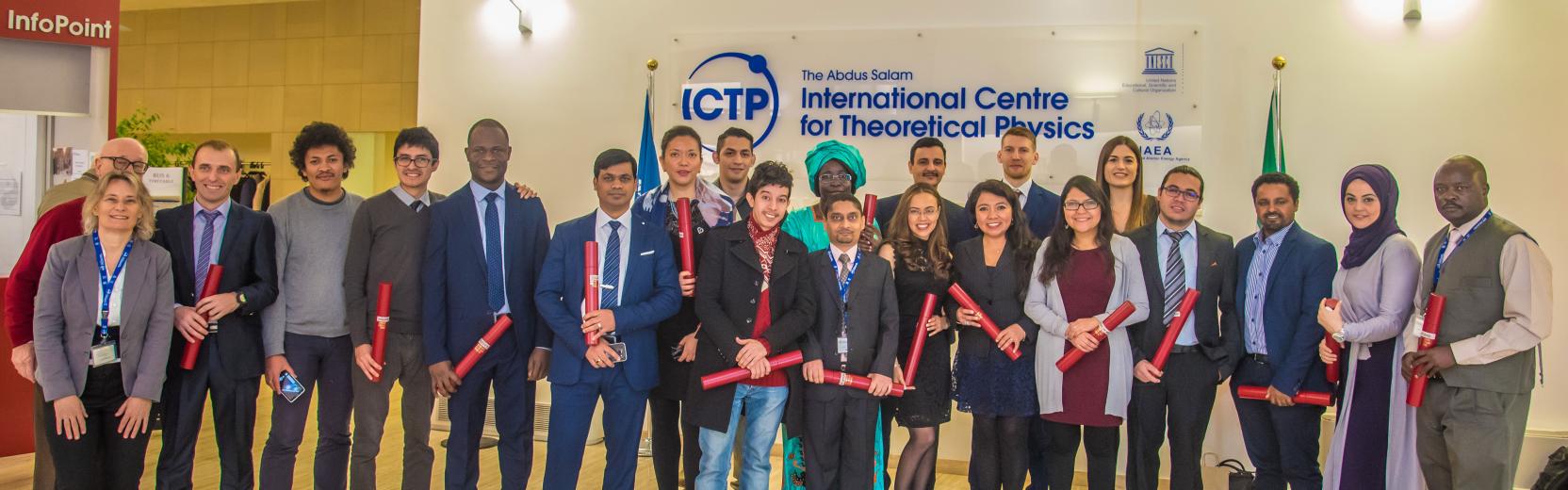
Thanks to his KFAS support, Salhi not only boosted his research skills and knowledge, but also became a member of ICTP's unique global community. Every year, some 50 students from across the world come together and share an intense one-year academic journey, during which the pressure can sometimes be high. “One needs to study hard in order to succeed, but the professors are very supportive and encouraging,” Salhi says, adding, “It is very refreshing to meet teachers and mentors who are genuinely willing to guide us and believe that we can succeed in our educational paths and careers.”
“One thing I really liked about the programme is the diversity that I encountered at ICTP. I had the chance to make friends with students from different parts of the world, to learn about their culture and share mine. We had a lot of fun together,” Salhi recounts. The diversity that one encounters at ICTP is both cultural and academic. “There is always something going on at ICTP–visitors, seminars, conferences, and people working in many different fields. It is a very enriching environment.”
After graduating from ICTP’s Postgraduate Diploma Programme in 2025, Salhi joined a PhD programme organised jointly by ICTP and the University of Trieste. In his research project, he will apply the tools he developed at the end of his diploma year to work on real data, focusing in particular on cratons, which are ancient and very stable parts of continents that have remained unaffected by tectonic movements for a very long time. “I am investigating their structure, how they formed and evolved,” Salhi says. “This has many purposes: on one hand, it will deepen our understanding of how the Earth evolved, but there is also a practical use to it: cratons are far away from the boundaries of the tectonic plates and earthquakes are very rare there. However, seismic events sometimes happen in these regions as well, but we do not know how. I would like to understand this better,” he adds. The plan is to consider data from South Africa, Australia and North America, which are highly monitored regions where cratons are located.
Although he is open to considering a career abroad, Salhi would like to contribute to earthquake safety in his country one day. “Earthquakes are hard to predict, which is why it is very important to keep an updated seismic hazards map,” he explains, adding, “By collecting and maintaining accurate data, we can better understand seismic phenomena and develop more accurate models. I want to contribute what I can to my country to make sure that disasters like the El Asnam earthquake do not happen again,” he concludes.