
seminars
07
Oct
2026
Mathematics
KӒHLER-EINSTEIN METRICS WITH LARGE SYMMETRY - LECTURE 4
Physical
Back
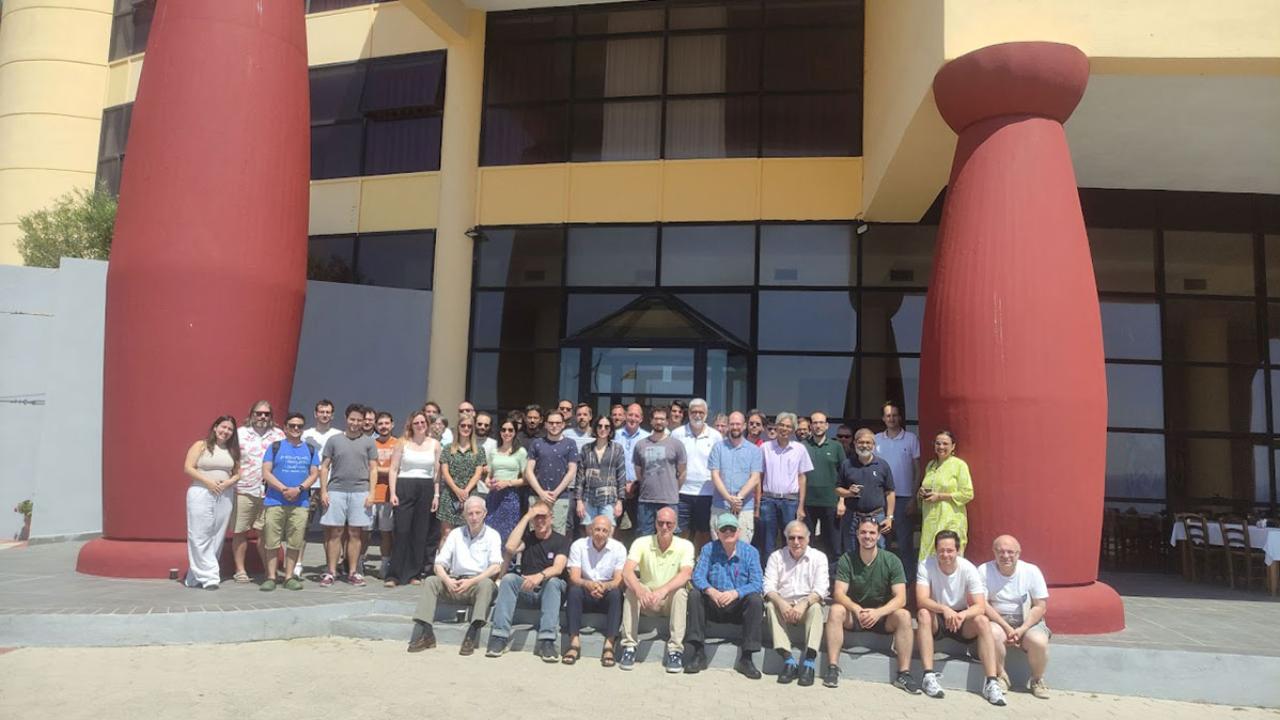
In 2025, two major scientific gatherings in Southeastern Europe—the 14th Regional Meeting on String Theory in Crete and the SEENET-MTP Workshop and Assessment Meeting (BWAM25) in Bucharest—demonstrated the vitality of theoretical physics across the Balkans and Eastern Europe. These activities, supported by ICTP and generously enabled by Michael and Nina Douglas, exemplify the vision behind ICTP’s proposed Eastern European Science Alliance (EESA).
Through sustained partnership-building, these initiatives are helping consolidate a long-standing scientific network into a structured, future-oriented alliance.
Hosted at the Orthodox Academy of Crete, the 14th Regional Meeting on String Theory continued a biennial tradition dating back to 2001. The meeting brought together string theorists from the Balkans to India to discuss the latest developments in string theory, quantum gravity, holography, cosmology, and related areas. Participation of senior researchers and early-career scientists alike fostered new collaborations and reinforced existing networks across institutions in Greece, Romania, Serbia, Bulgaria, India, and Western Europe.
In Bucharest, BWAM25, organized as a satellite event to the Balkan Physical Union Congress and hosted by the National University of Science and Technology Politehnica Bucharest, convened researchers across high-energy theory, mathematical physics, cosmology, integrable systems, and quantum field theory. Alongside scientific sessions, the SEENET-MTP Scientific Advisory and Executive Committees assessed ongoing activities and outlined strategic priorities for the coming years. BWAM25 strengthened the SEENET-MTP research network, increased visibility for emerging researchers, fostered deeper integration of Balkan institutions into the global physics community, and advanced discussions on formalizing the EESA.
These 2025 activities are integral components of ICTP’s broader strategy to formalize the Eastern European Science Alliance. Since its founding in 1964 by Abdus Salam, ICTP has served as a scientific gateway between East and West. Located in Trieste, historically a crossroads between Western Europe and the Balkans, ICTP has long supported researchers from Eastern Europe through schools, workshops, affiliated centers, and mobility programs. The EESA seeks to consolidate these efforts into a structured framework supported by matched public–private funding, ensuring sustainable opportunities for collaboration, training, and scientific growth.
In a conversation with ICTP, Michael and Nina Douglas explained that their support for the two events reflects a special connection they feel to Southeastern Europe and their desire to strengthen collaboration among theoretical physicists across the region. They expressed their delight in helping make both meetings possible and their hope that these initiatives will reinforce scientific ties throughout Eastern Europe. While noting that workshops, mobility support, and institutional engagement are all important, they emphasized in particular the need to bring talented young researchers into the community, describing them as the future of the field. Looking ahead, they warmly affirmed their interest in seeing their support contribute to formalizing the Eastern European Science Alliance and expanding these opportunities in partnership with the International Centre for Theoretical Physics.
If you are interested in learning more about supporting ICTP, please contact us at advancement@ictp.it.
To support ICTP, click here. To learn about tax-deductible giving in the United States, please click here to request more information.