
seminars
17
Nov
2026
High Energy, Cosmology and Astroparticle Physics
HECAP Seminar by Gregoire Mathys - A Positive Metric on 4d QFTs
Hybrid
Back
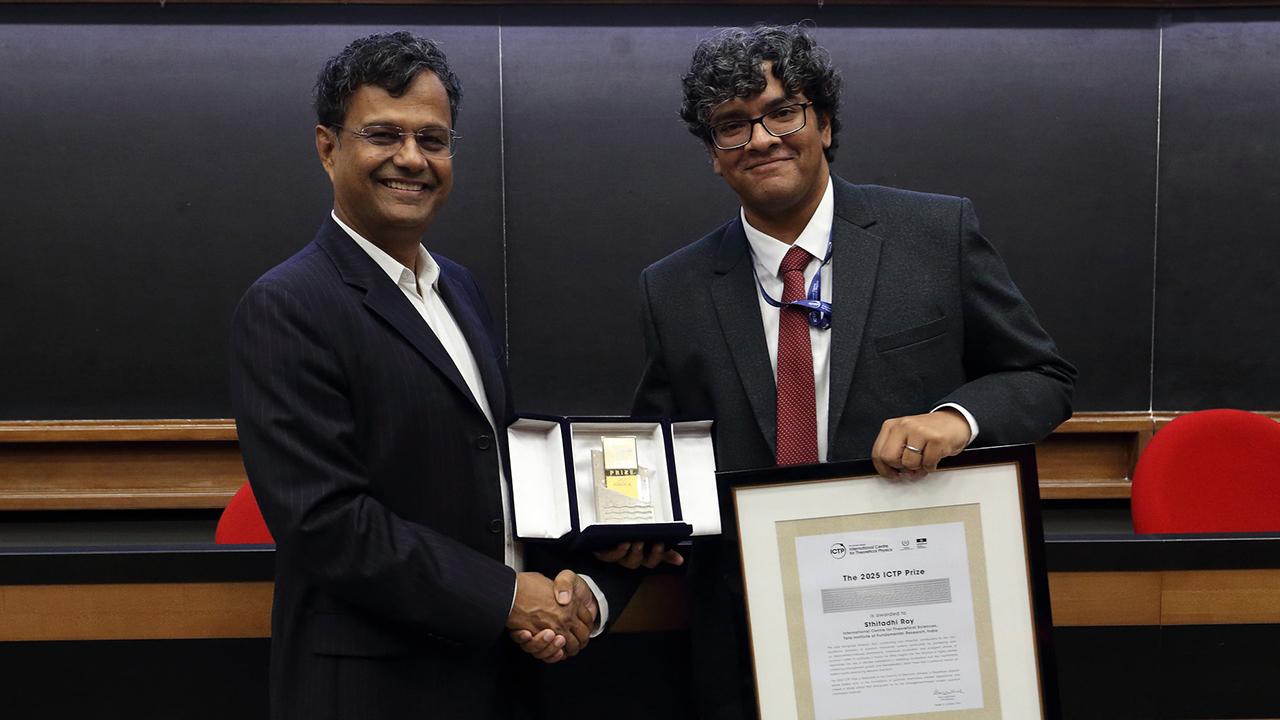
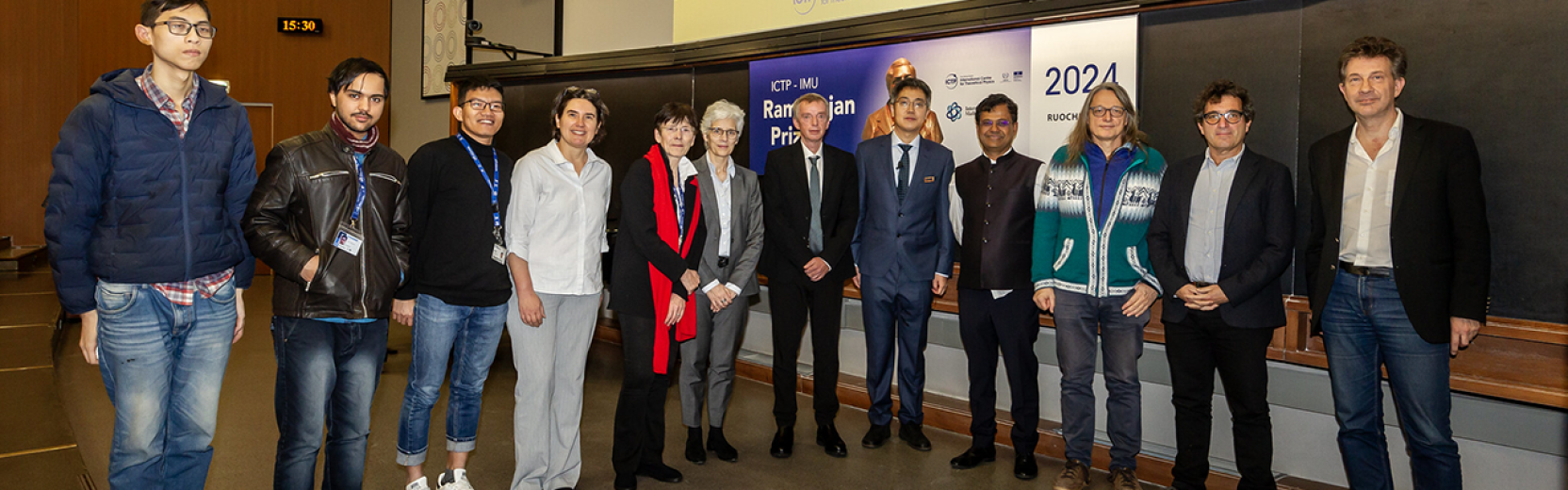
The 2025 ICTP Prize awardees Sthitadhi Roy of the Tata Institute of Fundamental Research, Bengaluru, and Titas Chanda of the Indian Institute of Technology Madras, India, visited ICTP to attend the ICTP Prize ceremony on 21 October 2026. It was the occasion to interview them and learn more about their work on the theory of quantum many-body systems at the interface of condensed matter and quantum information science. Below we publish an interview with Sthitadhi Roy.
What would you say has been your most important contribution among the ones that have been recognised by the ICTP Prize?
One of the main topics that I have been working on over the past eight years is related to ergodicity breaking.
If you take a block of ice and keep it at room temperature, it will melt into water. That is thanks to a process called thermalisation, according to which the block of ice will exchange energy with the ambient environment, and eventually reach a new equilibrium phase where the water has the same temperature as the room. This process is underpinned by the fact that the block of ice, as most systems around us, behaves in an ergodic way: if you leave it on its own, over a certain period of time its molecules will explore sufficiently many different possible states to ensure that macroscopically the system will behave according to the laws of thermodynamics.
Things change in the quantum world, first of all because there we usually deal with isolated systems. Quantum applications, such as quantum computers or devices that do information processing, require that the system is as isolated as possible, otherwise part of the information that we want it to process would be lost into the environment due to quantum entanglement, a property according to which quantum systems tend to communicate with each other and share information. Because isolated systems are by definition not in contact with the external environment, they can never thermalise. However, one can consider small subsets and look at how their average energy evolves compared to that of the rest of the system. We will say that the system is thermalised when any small subset is. This process is again underpinned by the idea of ergodicity, according to which over a sufficiently long period of time the system will be able to explore a large fraction of all possible states. This is indeed the case for most systems, also in the quantum world.
We have found that if the system is characterised by strong disorder, something quite common in real materials, then the physics I have just described breaks down: there will be small regions in the system that cannot communicate efficiently with the rest, and therefore cannot explore all the possible configurations that are required for thermalisation. The system is therefore not ergodic and this phenomenon is known as many-body localisation. The words “many-body” highlight that these quantum systems consist of many particles, while the term “localisation” refers to the fact that the information or the energy are localised in a small region. Going back to our example of the ice in a chamber, this means that in a quantum equivalent of the system, there could be situations where the ice does not melt, despite the high ambient temperature.
Why is this important?
It is important for two reasons. On one side, we find that this is a stable phase: the energy remains localised even if you change some parameters in the system. But there are also more practical reasons: because the information of a subregion does not escape to the rest of the system, you can use many-body localisation to create devices that store information in an efficient manner. In a many-body localised system, entanglement does not grow, or it grows very slowly, because one part of the system does not become entangled with the rest.
How can this property be exploited in applications?
To understand why this ergodicity breaking is interesting, you need to consider that what we want to do in any quantum information processor, for example a quantum computer, is to encode some information in a quantum system and then transfer that quantum state to someone else, who should be able to retrieve that information through some type of measurement.
The biggest obstacle to that so far has been entanglement: quantum systems tend to talk with their environment, which can be a problem. To understand the implications, imagine that you need to remember a certain long sequence of numbers and that you shared it with a friend so that he can help you remember it. Instead of keeping it to themselves, your friend did the same and shared it with many other people, in a way that everyone just remembers a small fraction of the original sequence. Now, the only way to recover the full information is to get everyone together, which is like saying that you need to perform your measurement on the full system, something that is very hard to do. If instead you could have only one person remember all the information, you could easily recover it by asking that one friend. This is the advantage of ergodicity breaking: many-body localised systems retain information efficiently. The bad side is that if someone wants to steal that information, the only thing they will have to do is to talk to that one friend or, in other words, get access to the region of the many-body localised system where you stored it.
What was your contribution to the discovery of many-body localisation?
That of localisation is a problem that dates back to the late 1950s. In 1957 Philip Anderson was the first to find that localisation shows up when one introduces disorder in a system of many quantum particles. He did so for the simplified non-interacting case. That was a remarkable result that no one had expected, because it has no equivalent in systems of classical particles. This motivated scientists to ask what happens in the more realistic case of interacting particles, but for many years the community struggled to find an answer. One reason is that, as I always tell my students, there are three factors that can make a physics problem hard to solve: disorder, interactions, and the absence of equilibrium. This problem had all three.
In 2006, Basko, Aleiner and Altshuler showed that if you introduce interactions, the system stops transporting current in the presence of an external voltage. This showed that localisation was possible also in the presence of interactions, which was confirmed by further numerical studies suggesting that there might be a phase transition between an ergodic phase and a non-ergodic phase.
A particularly paradoxical and confusing aspect of the problem was that this non-ergodic phase appeared to be stable. Suppose I give you a system of N spins. Any of them can take 2 values (plus or minus 1), so there are 2^N (2 to the power N) possible configurations overall. These configurations live on a very complicated graph, where there are many options to go from one point to the other. It seemed very counterintuitive that the system did not manage to explore all these points given that there were so many paths it could follow. One of our main contributions was to show that, even if there are many routes that the system can explore to escape its localised configurations, the disorder on the graph is highly correlated, which makes the paths highly correlated: if you block one path, that automatically blocks many others. My collaborators and I put this on mathematical footing and showed how it happens. This is one of the most important contributions of my work.
What does this prize mean to you?
While as scientists we do research because we love it, it means a lot to me that my work is being recognised and this prize serves as an important encouragement. I have only been a faculty member for a few years and I take this award as an acknowledgement that the work that I have been doing is meaningful. It also shows the value of continuing to work on hard problems.
Have you been to ICTP before and what are your impressions about the centre?
I was here once to attend a workshop, but it was so long ago that it feels as if I am here for the first time. It is great and humbling to see how many eminent scientists have visited over the years. ICTP is an outstanding research institute and I am happy that my work has been recognised by ICTP.
How do you think initiatives like the ICTP Prize, which is reserved for scientists from the Global South, can help researchers in the most disadvantaged regions?
I hope this prize can motivate young students and postdocs. Education and scientific research are the backbone of the development of a country, and we need people who are willing to contribute to scientific advancements. There are many students who are extremely bright and hard-working but sometimes they lack the right exposure and awareness to choose research as opposed to another career path. I hope that an award like this can motivate them to continue doing science. That is also important in today’s world where there is some pessimism about research in the age of AI.
What do you make of the worries, shared by some, about the impact that AI is having on scientific research?
I believe we need to find ways to use AI that will make research better and more efficient, and I disagree with those who come to the conclusion that if AI can do anything then there is no space for researchers any more. Of course, the way we do research will have to change, but at this stage I do not believe that research will be entirely done by AI. Things are changing so fast that the discussion that we are having now might not be relevant in a month, but I also think that some fields, especially those where the research questions are well defined or where there is a strong reliance on data analysis, will be impacted more than others. At the moment AI is very good at answering some kinds of questions and it will get better at it, but humans will continue to have a very important role to play. It will become a very synergistic activity: humans will benefit from AI and AI will also receive some benefit from its interaction with human beings.
Do you use it in your research?
I have started only very recently. I ask AI specific, direct questions. Because it has access to so much information, I use AI, for example, when there is a mathematical step or a mathematical structure that I cannot figure out, to learn if there are ways in which this can be done, if there are other theorems that I can use, or if there are any relevant research papers out there. I have also used it to understand and improve code. I have not got to the point where I ask it to answer an actual research question. Well, I did give it a try but the answer was not satisfactory, and that is the source of my optimism. At least for now, AI is not very good at answering vague questions, but that is exactly what we do in research: we start from vague ideas, try out something and refine the question along the way. We learn a lot in the process and we learn as well from actually doing the analytical and numerical calculations. These are our window into the system and not a step we can just skip. I also have this feeling that eventually all these AI models will become very similar, which will mean that human creativity will again become important. Finally, I would like to say that the joy of discovering new things when we do research is something no AI can take away from us.