

seminars
13
Nov
2026
International Day of Medical Physics
Physical
Back
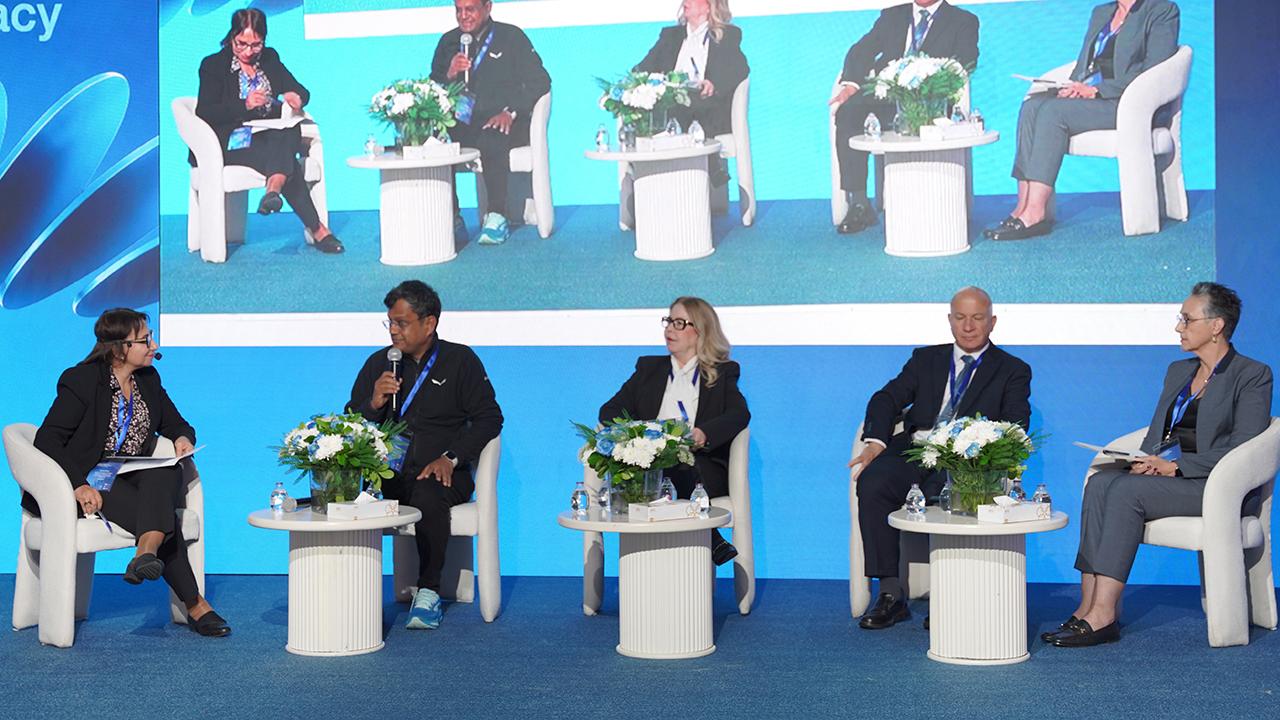
A Jordan-based, independent laboratory currently counting Cyprus, Egypt, Iran, Israel, Pakistan, Palestine, and Türkiye among its members, the Synchrotron-light for Experimental Science and Applications in the Middle East (SESAME) is a unique example of collaboration through science in a region torn by conflict. Its premises were chosen to host a symposium on the Role of Research and Technology Infrastructures in Science Diplomacy, organised by the European Commission in cooperation with SESAME, UNESCO, and the Union for the Mediterranean (UfM) on 28 October 2026.
Scientists, policy makers, diplomats, leaders of scientific facilities and international organisations gathered in Allan, Jordan, to discuss the importance of science diplomacy in a divided world. “It’s particularly fitting that we gather at SESAME to discuss science diplomacy,” said Gihan Kamel, Infrared Beamline Principal Scientist at SESAME, who chaired the symposium. “Since its inception, SESAME has been standing as a testament that science can serve not only as a driver of discovery and innovation, but also as a bridge between nations. As the international community seeks solutions to our increasingly complex and joint challenges, the need for stronger connections between science, policy and diplomacy continues to grow,” she added.
The meeting was attended by Her Royal Highness Princess Sumaya bint El Hassan of Jordan, who talked about the role of research and technology infrastructures in science diplomacy, highlighting the important role played by SESAME in the Middle East. “This structure that we celebrate today, and more importantly the growing community it nurtures, and the hopeful science it creates and sustains, is a wonderful and concrete example of science diplomacy in action. It represents for our region, science diplomacy at its most ambitious and creative,” she said.
ICTP Director Atish Dabholkar was one of the panellists at the round table on Research and Technology Infrastructures as Instruments of International Cooperation and Peace Building, which discussed how research infrastructure can lead to tangible impact.
Dabholkar stressed the need for scientists to come together in the face of global challenges and shared ICTP's experience as a concrete example of global collaboration. “The challenges before us are of such magnitude that humanity will have no other option than to collaborate,” said Dabholkar, adding that “Places like ICTP, CERN and SESAME show that large infrastructures are not really of value unless there is a human infrastructure that accompanies them. Over its more than 60 years of history, ICTP has successfully established a network of close to 200,000 scientists around the world that we can contribute to supporting new projects to ensure that there is human capacity that brings them to life.”
“It is not only by bringing people together that collaboration continues. It’s also through the way we run the places that host these collaborations that we can ensure and guarantee the continuity of these efforts,” said Amal Kasry, Chief of Section for Basic Sciences, Engineering, Technology & Innovation, UNESCO, who moderated the panel.
Dabholkar also recalled the key role that ICTP played in the founding of SESAME and its continued collaboration with the synchrotron facility. The idea of such a regional scientific centre was proposed by ICTP founder Abdus Salam in 1983, motivated by the conviction that scientific cooperation could pave the way for future peace and collaboration between countries in the Middle East. ICTP also supported one of the first founding conferences in Dahab, Egypt, and continues to train generations of scientists who work at SESAME.
On the day of the symposium, ICTP's longstanding collaboration with SESAME and the Royal Scientific Society of Jordan (RSS) was renewed through a new Memorandum of Understanding signed by the President of the RSS, Her Royal Highness Princess Sumaya bint El Hassan, along with the Director of SESAME, Professor Khaled Toukan, and ICTP Director Dabholkar. The document affirms the parties’ strong interest in mutual cooperation and aims to promote scientific research and education, training and communication in Jordan and the Middle East and North Africa region. These collaborations exemplify ICTP's efforts to build an International Science Alliance, a global network of science organisations, national institutions and private partners, with ICTP at its core, aiming to advance global science.