
scientific activity
26
Oct
2026
29
Oct
2026
TWAS Science Policy Dialogue | (smr H728)
Physical
Back
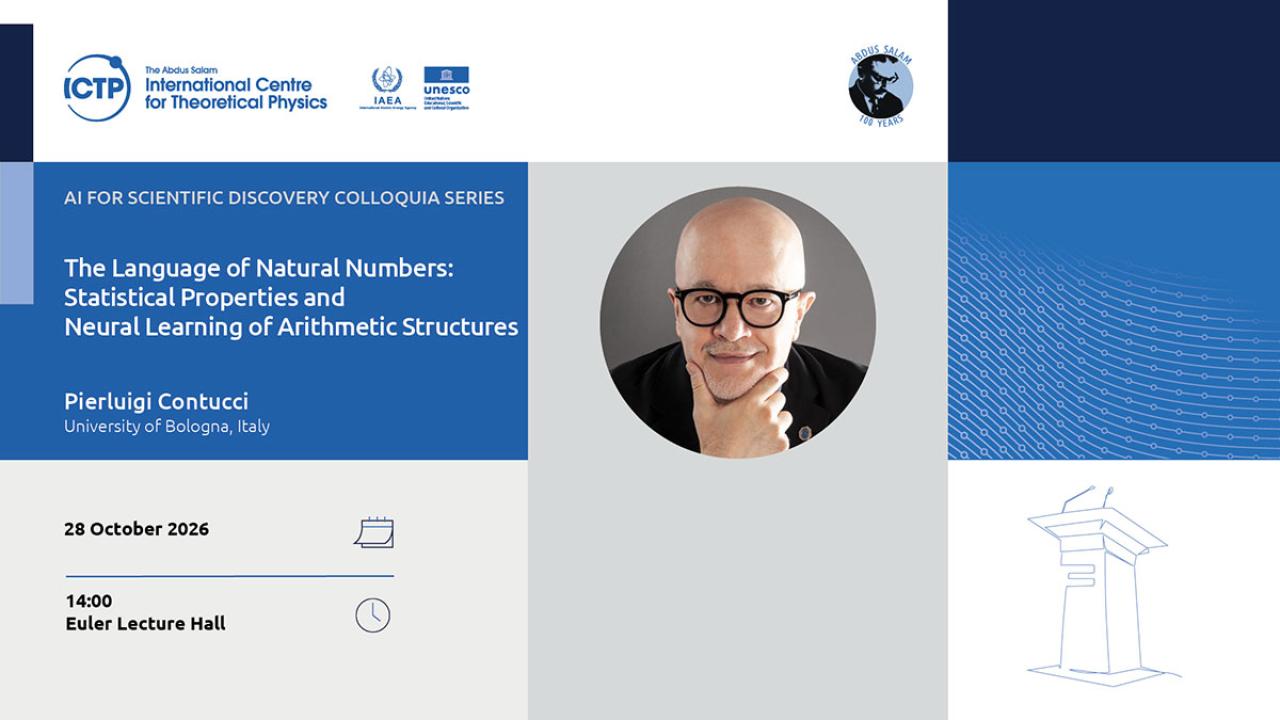
ICTP is pleased to announce the second in its series of colloquia on AI for Scientific Discovery, exploring how artificial intelligence is transforming fundamental scientific research.
On Wednesday 28 October, Pierluigi Contucci of the University of Bologna will give a talk titled "The Language of Natural Numbers: Statistical Properties and Neural Learning of Arithmetic Structures".
The colloquium will take place in the Euler Lecture hall starting at 14:00, and will also be livestreamed at ictp.it/livestream.
Pierluigi Contucci is a professor of mathematics at the University of Bologna. His research interests include mathematical physics, statistical mechanics and applications (machine learning, data science). He writes on scientific debates of public interest in newspapers like Il Corriere della Sera, Il Sole 24 Ore and magazines like Il Mulino and Vanity Fair. He is a recipient of the Schloessman Award (2000) from the Max Planck Society, and a member of the Science Academy of Bologna.
Colloquium Abstract:
The relationship between artificial intelligence and science is increasingly bidirectional: AI offers new tools for discovering and exploring scientific structures, while science provides controlled domains in which to investigate the capabilities and limitations of AI. Contucci will examine this interplay in the fundamental setting of arithmetic. Iterated prime factorization turns the integers into a deterministic sequence of words whose vocabulary and admissible combinations are governed by arithmetic. He will discuss asymptotic laws for vocabulary growth and word frequencies, examine statistical dependencies, and show that a transformer trained solely on such text captures structural regularities, including sensitivity to arithmetically forbidden sequences. This resulting language supports both directions of inquiry: neural models make arithmetic structure accessible through learning, while arithmetic supplies precise constraints against which to examine what these models learn and how they represent it.