
seminars
13
Oct
2026
02
Mar
2027
Earth System Physics
ESP Seminar - Tuesdays 11:00 CET
Hybrid
Back
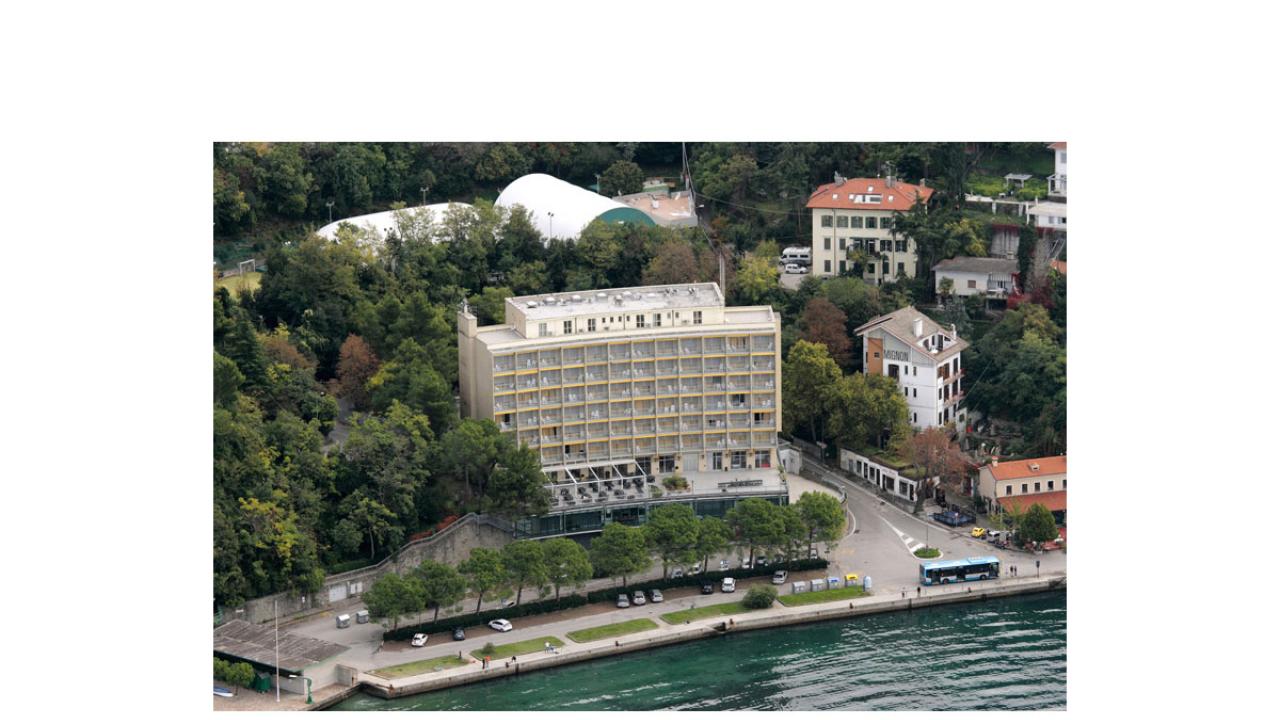
An international partnership between the Fondazione Compagnia di San Paolo (FCSP), Simons Foundation International (SFI), and Italy's Friuli Venezia Giulia Autonomous Region has pledged to support ICTP's vision of transforming its iconic Adriatico Guesthouse (AGH) in Trieste into an International Science Complex.
That vision, which is at the heart of ICTP's 5-year strategic plan, is now one step closer to reality after Fondazione Compagnia di San Paolo purchased the AGH on behalf of ICTP, whose international statute prevents it from owning buildings, securing the building for ICTP's long-term use. The purchase was announced at an event in New York attended by representatives of the partnership as well as the Italian Ministry of Foreign Affairs and International Cooperation (MAECI), on 16 October 2026. Italy has hosted and supported ICTP since the Centre's founding by Nobel Laureate Abdus Salam in 1964.
The acquisition paves the way for transforming the AGH into an International Science Complex with modern lectures, events and accommodation facilities to host the thousands of scientists from around the world who visit ICTP every year to attend scientific meetings and form international collaborations. That acquisition and transformation is being funded by a major matching grant (USD 15 million) from SFI, a philanthropy whose mission is to advance the frontiers of research in mathematics and the basic sciences. Funding (Euros 4,250,000) has also been pledged from the Friuli Venezia Giulia Autonomous Region, the Italian territory where ICTP is based. Further financial resources will come from ICTP's major fundraising campaign, ICTP 2.0, which has already secured over EUR 8 million and is actively fundraising to fully match the SFI grant to complete the first phase of the project.
In line with making the renovated space a unique, energy-efficient, state-of-the-art facility, an architectural firm will be selected, via an international competitive design competition, for the redevelopment, which will transform the Adriatico into an integrated hub combining research, education and collaboration. The first phase, which closed on 14 October 2026, invited candidates to apply; results are expected in December 2026, when a shortlist will be announced and invited to submit full design proposals.
“With more than 40% of lectures and seminars organised by ICTP taking place there, the Adriatico building is an integral part of the ICTP experience for the some 4,000 scientists from more than 150 countries who take part in ICTP’s activities there every year. We are very grateful to Fondazione Compagnia di San Paolo, Simons Foundation International and the Regione Friuli Venezia Giulia for their support, which will be essential to keep this environment alive and turn it into a modern, international scientific complex,” said ICTP Director Atish Dabholkar, adding, "We are also grateful to our many individual donors whose support has built incredible momentum for our fundraising efforts."
For more than 40 years, ICTP has been using the building, which was constructed in the 1970s, to host visiting scientists and hold international workshops and schools under a rental agreement with a private real estate firm. With the acquisition of the building on ICTP’s behalf, the Centre can now invest directly in its future as a long-term scientific home, with 100 guest rooms, a cafeteria, lecture rooms, laboratories and offices supporting its international community. For many years, the building also housed the science museum Immaginario Scientifico before it moved to Trieste’s Porto Vecchio.
The International Science Complex project unites four players who each have demonstrated a deep commitment to the support of science: ICTP, with its 60+ years of promoting sustainable science in the developing world; Fondazione Compagnia di San Paolo, with its collaboration with the United Nations Secretary-General’s Scientific Advisory Board, in addressing the UN Sustainable Development Goals; SFI; and the Friuli Venezia Giulia Autonomous Region, whose capital, Trieste, is home to the largest concentration of scientists in Italy.
“We are longtime backers of the ICTP, supporting its place as a haven for physicists from around the world to gather and collaborate,” says Simons Foundation International President David Spergel. “The Adriatico Guesthouse is such an important part of ICTP’s collaborative culture, and we’re thrilled that this acquisition will make it a permanent part of the centre.”
"This project brings philanthropic and public resources together around a shared goal: keeping science open, accessible, and connected across borders. We believe that scientific knowledge is a global public good, and that philanthropy has a responsibility to invest in the infrastructures that sustain it. Over the years, Fondazione Compagnia di San Paolo has built significant experience in regenerating complex buildings in Turin through international design competitions – from Cavallerizza Reale to Museo Egizio – and we now bring the same expertise to the Adriatico. We are honoured to work alongside ICTP and UNESCO, Simons Foundation International and the Regione Friuli Venezia Giulia on an initiative that shows how private and public actors, working together, can strengthen the foundations of international scientific cooperation” said Marco Gilli, President of Fondazione Compagnia di San Paolo.
“The Friuli Venezia Giulia Autonomous Region is proud to support the transformation of the Adriatico Guesthouse into an International Science Complex. Our €4.25 million commitment reflects a clear strategic choice: to strengthen Trieste’s role as an international hub for science, cooperation and knowledge. ICTP is a unique asset for our territory and for the global scientific community: this project will further enhance its capacity to bring together researchers from across the world and to build lasting bridges through science,” said Massimiliano Fedriga, President of the Region.
About the partners
For more than 60 years, the Abdus Salam International Centre for Theoretical Physics (ICTP) has been a driving force behind global efforts to advance scientific expertise in the developing world. Founded in 1964 by the late Nobel Laureate Abdus Salam together with Italian physicist Paolo Budinich, ICTP is a unique institution that explores fundamental scientific questions at the highest level, promotes active engagement with scientists in developing countries, and advances international cooperation through science. ICTP operates under the joint auspices of UNESCO, the International Atomic Energy Agency (IAEA) and the Italian Government. For more information, visit www.ictp.it
Simons Foundation International (SFI) is a Bermuda-based philanthropy whose mission is to advance the frontiers of research in mathematics and the basic sciences. The foundation supports research in the United States and around the world, as well as local science and other charitable work in Bermuda. The foundation receives administrative support from the Simons Foundation. For more information, visit sfi.org.bm
Fondazione Compagnia di San Paolo (FCSP) an international philanthropic foundation,
an intermediary, a vehicle for social freedoms and an agent of innovation and sustainable development nationwide, whose values have centred upon individuals and the community, since 1563. The Foundation operates internationally to promote innovation and sustainable territorial development, placing the values of people, their rights and their responsibilities in society at the heart of its activities. For more information, visit www.compagniadisanpaolo.it
Located in the northeastern corner of Italy and regarded as a hub for science and technology, the Friuli Venezia Giulia Autonomous Region is home to 22 scientific institutions engaged in research, development, and innovation. The region boasts a large community of foreign scientists and students and a significant network of public and private research institutions that benefit from international research infrastructures and often work in synergy with economic and innovation stakeholders. For more information, visit www.regione.fvg.it