
school
17
Aug
2026
28
Aug
2026
Mathematics
2026 School on Arithmetic, Geometry and Algorithms | (smr 4199)
Physical
Back
Island nations in the Pacific region are on the frontline of climate change. From rising sea levels to energy instability, these vulnerable archipelagoes and atolls are facing an uncertain future. Add to that the high costs of overcoming the isolation of island life and an under-developed science community and you have a region at a crossroads for sustainable development.
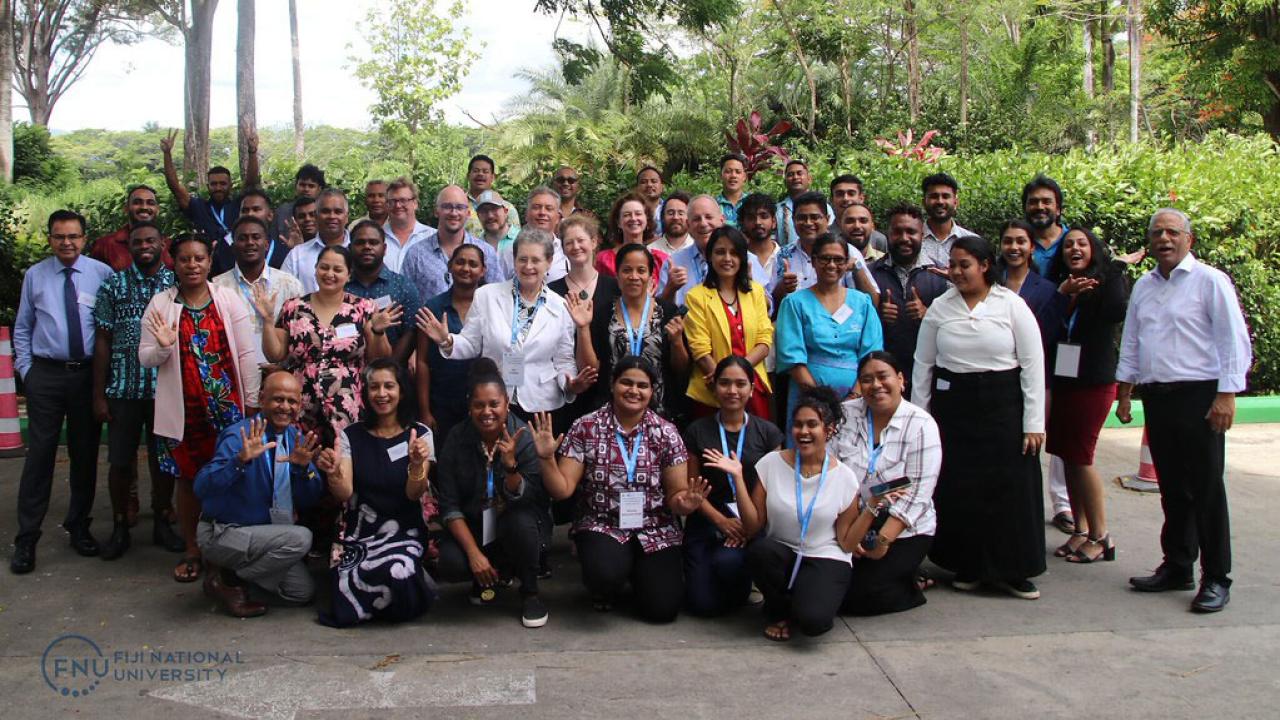
In an effort to address the challenges, scientists from ICTP joined representatives from several international organizations and regional universities to discuss a cooperative strategy to develop physics in the region.
The Pacific Island Physics Summit, held in Fiji from 18 to 19 November 2025, was conceived and carried out by the International Union of Pure and Applied Physics (IUPAP) together with UNESCO, ICTP's UN partner. The meeting discussed the state of physics in the Pacific Islands, highlighting the lack of infrastructure and international connections among scientists in the region.
Riccardo Farneti, a climate scientist in ICTP's Earth System Physics section who attended the summit, described the participants excitement at being all together, physically, in one place to talk physics. "This rarely happens, because it is expensive and time consuming to travel among the islands. They were enthusiastic about working together to overcome the challenges of the state of physics in the region," explains Farneti.
To foster collaboration, ICTP will assist in keeping the momentum of the summit going by helping scientists from the region organise an activity to take place in 2027, potentially focusing on climate change or renewable energies.
Along with fostering collaboration, the summit highlighted the need to encourage more youth to study physics. "Participants reported that in the region, people don't want to study physics and maths because they think that the only career option is to be a school teacher. We were trying to tell everyone, 'You can be a physicist and a mathematician and then end up doing working on climate change related studies'. You can end up working on renewable energies, or working in an insurance company as a physicist or a mathematician. There's a huge portfolio of jobs and activities that you can do," says Farneti.
This sentiment was echoed by Shilpa Lal, a Fijian PhD student at the University of Toulouse who is based at the Institut de Recherche pour le Développement (IRD) in Noumea, New Caledonia. Lal's attendance at the Pacific physics summit was sponsored by ICTP. "There is a lack of awareness of the utility of a physics education and its "industrial" or real world applications," says Lal, adding, "Most students take up physics in undergrad because they would like to be high school teachers teaching physics. They are not aware of many other job prospects where physics knowledge would be useful, such as in material science."
For her PhD studies, Lal is characterizing past marine heatwave events that have happened in the Southwestern Tropical Pacific (SWTP), in terms of the spatial extent, vertical extent and seasonality and trends and their implications on coastal fisheries. To enrich her studies, Lal attended an ICTP summer school on marine heatwaves in Trieste in the summer of 2023. It allowed graduate students to showcase their work on marine heatwaves through posters and oral presentations and allowed professors and post docs to share their skills and knowledge through workshops and seminars, she recalls. These types of opportunities are key to developing physics in the Pacific region, Lal says, as are exchange programmes that would bring Pacific region students to ICTP for training and mentoring. "I think this opportunity will be very much appreciated by students of the Pacific, and they will benefit greatly by the infrastructure and the research experience at the ICTP," says Lal.
Parallel to the Pacific Island Physics Summit, IUPAP and UNESCO organised a 'bootcamp' on entrepreneurship for young scientists to teach the basics of launching a start-up business. More details about that meeting can be found here.