school
05
Oct
2026
09
Oct
2026
Joint ICTP-IAEA Nuclear Knowledge Management School | (smr 4240)
Physical
Back
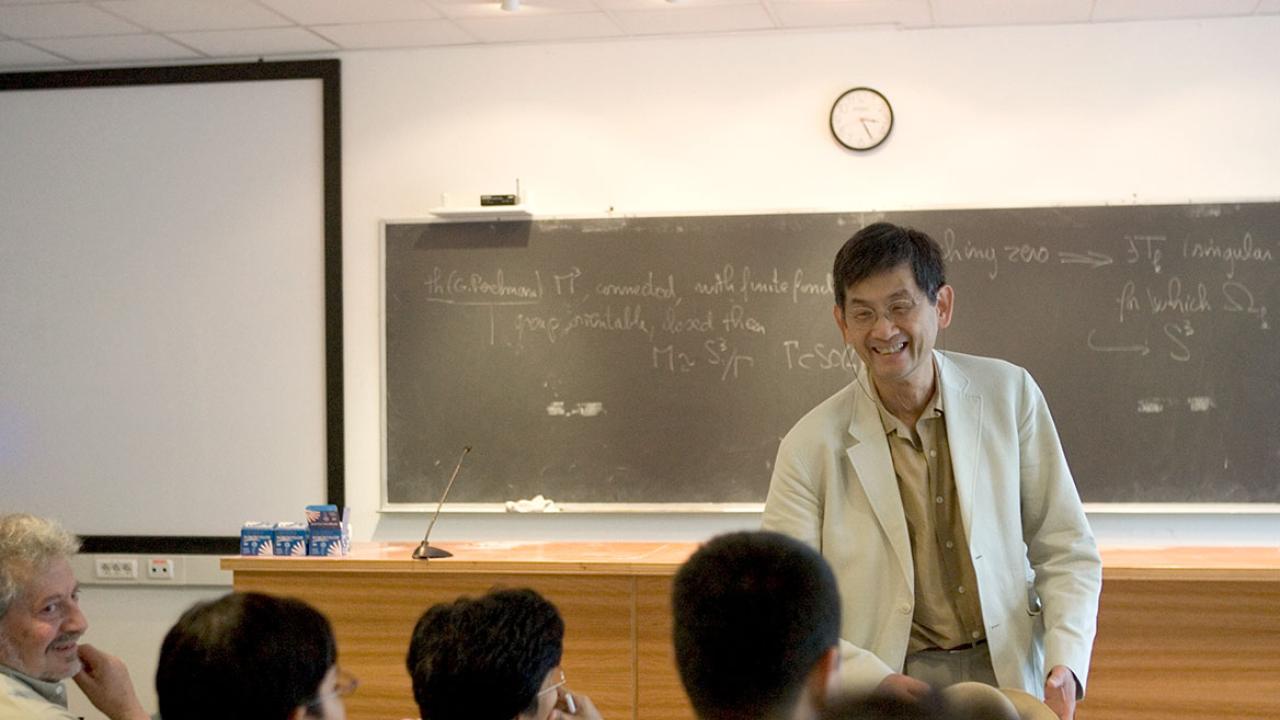
ICTP was saddened to learn of the passing of mathematician Lê Dũng Tráng, former head of the Centre's Mathematics section.
According to his close collaborator, French mathematician Professor Bernard Teissier of Paris Diderot University, Lê was emeritus professor at the University of Aix-Marseille, France. He was educated at Lycée Voltaire and Lycée Louis-le-Grand, Paris and Paris University, and was editor of the International Journal of Mathematics, Journal of Singularities and Acta Mathematica Vietnamica. He was awarded the Prix d’Aumale by the French Academy of Sciences in 1990, and elected to the World Academy of Sciences in 1993.
Lê also worked energetically for the development of Vietnamese mathematics and in particular promoted the invitation to Vietnam of foreign mathematicians. He made major contributions to the study of the topology of singular complex analytic spaces and mappings. His main research was concerned with singularity theory in the complex domain (Milnor fibrations, perverse sheaves).
ICTP has received tributes for Professor Tráng from former colleagues and students; several are shared below.
T.R. Ramadas, former head of ICTP's Mathematics section:
Lê joined ICTP as head of the Mathematics section at around the same time that I joined as a staff member in Mathematics. He cut a dapper figure with his well-tailored suits and hats, and managed the section quite effectively and with a light hand -- something that I did not fully appreciate until I succeeded him some years later.
Lê used to regale us with stories of his early days in Paris and Grothendieck's informal ways with the CNRS bureaucracy. He arranged for many illustrious mathematicians to visit ICTP, of whom Vladimir Arnold made the strongest impression on me. Lê's good friend Bernard Teissier was a frequent visitor and I enjoyed his company very much. The schools on Hodge theory and related topics that Lê organised were of a very high level -- I wish I had made better use of them.
One of Lê's best known works was with C.P. Ramanujam, who was a legendarily broad mathematician from the Tata Institute of Fundamental Research (TIFR) in Bombay. CPR (as he was known to everyone) had passed on before my time at TIFR, but I heard about this joint work during my graduate student days, long before I met Lê. It is my impression that this collaboration, as well as his Vietnamese background, gave Lê some insight into the South Asian psyche.
Alberto Verjovsky, former collaborator:
Lê Dũng Tráng (1947–2025) was born in Saigon and raised in France. He rose to become one of the world's leading experts in Complex Singularity Theory, with a career spanning over five decades across Europe and beyond. His deep contributions—from foundational theorems on Milnor fibrations and topological invariance to modern advances in monodromy and perverse sheaves—have profoundly shaped the landscape of geometry and topology.
I had the fortune of meeting him in México City in 1985. At that moment, he was a professor at Université de Paris VII, Campus Jussieu. From that moment, we established a friendship that lasted until he passed away. We interchanged many mathematical ideas, and he became a valued collaborator of various mathematicians from México and Latin America.
Professor Lê is also celebrated for his role as a crucial bridge between the Vietnamese and international mathematical communities. He was instrumental in helping Vietnam join the International Mathematical Union (IMU) in 1974 and tirelessly mobilized funds to organize conferences and lectures, supporting and developing young Vietnamese mathematicians as they integrated into the global academic community. As a mentor, he guided many students who themselves became influential mathematicians.
I remember recommending him to apply to become the Head of the Mathematics Section at the Abdus Salam International Centre for Theoretical Physics (ICTP), since he was perfect for such a position. Indeed, he was the head from 2002 to 2009, during which time he played an essential role in its development.
I fondly remember the many mathematical discussions we had over the years, and his friendship.
Jaiyu Li, former ICTP colleague:
I am very sad learning that Professor Lê passed away.
Professor Lê was a great mathematician the world has ever known for his significant contributions in singularity theory.
I first met Professor Lê at ICTP, when he was the head of the mathematics group. Devoted to his work, he went to many developing countries to organize schools and conferences. He once organized a summer school in Libya in 2007, and we spent one month there. More than 200 participants from all fields in mathematics joined the school. It was a big event; there he was not only an organizer, but also a lecturer. During those years, many post-doctorates from developing countries were lucky to have the chance studying in the mathematics group. Obviously, his efforts broadened the vision of the scholars.
He was my close friend. After I went back China, he visited me four times, we had wonderful conversations on how to study mathematics, how to guide students, and how to develop mathematics.
Even till now, I could not believe he had been really away from us. When I take a walk after dinner, I am always reminded of his ceaseless work in the mathematics field. He shines like a star upon us. He will be missed forever.
Roland Rabanal, a former postdoc:
I was deeply saddened to learn of the passing of Professor Lê Dũng Tráng on November 19, and I extend my heartfelt condolences to all who knew him. During my time in Trieste, I had the honor of being his postdoctoral student and benefited greatly from his guidance.
I also fondly remember his visit to my university in 2012, when he delivered the Cátedra José Tola Pasquel, offering both a course and a plenary lecture that inspired many of us. His significant contributions and inspiration will be remembered by students and colleagues alike, and his legacy will continue to enrich the mathematical community. May his memory bring comfort during this difficult time.
Ngô Việt Trung, former collaborator:
“Dedicated to my home land, the heroic Vietnam”
Those were the opening lines of Lê Dũng Tráng’s doctoral thesis in 1971, when he was only 24 years old. Strangely, at that time he did not have the French nationality but the nationality of the Democratic Republic of Vietnam, although he grew up entirely in France and knew about Vietnam only through his family’s stories. Professor Lê Dũng Tráng was born in 1947 in Saigon. In 1949, his family moved to France when he was 2 years old. He really knew about his country only when he visited Vietnam for the first time in 1972. We can wonder what attached the young man Lê Dũng Tráng to Vietnam so much.
Lê Dũng Tráng was probably one of the youngest people to obtain a doctorate in France (Doctorat d'État) at the time he defended his thesis. At that time, defending a doctoral thesis in France was difficult, having to go through 2 steps. He defended the first step (Doctorat de Troisième Cycle) in 1969 when he was only 22 years old. According to his mathematics genealogy, his thesis advisors were two of the world's leading mathematicians, Claude Chevalley and Pierre Deligne (Fields Medal 1978). His defense committee included Francois Norguet, Yvette Amice, Pierre Deligne and Rene Thom (Fields Medal 1958). His thesis was influenced by a series of lectures by Heisuke Hironaka (Fields Medal 1970) on the relationship between algebraic and topological properties of complex analytic hypersurfaces at the Institute for Advanced Study IHES in 1968. Together with the Indian mathematician C.P. Ramanujam, Lê Dũng Tráng solved a conjecture of Hironaka on this relationship in 1976. This is probably his most famous work, laying the foundation for many later studies in singularity theory. He is also famous for the Lê-Greuel formula, Lê cycles and Lê numbers bearing his surname. David Massey wrote a book called "Lê cycles and hypersurface singularities". He kept doing mathematics until his death. On October 17, 2025, he posted a research paper on the Arxiv (arXiv:2510.15825).
Lê Dũng Tráng was a professor at the University of Paris 7, the Ecole Polytechnique of Paris, and the University of Provence-Marseille. Before retiring, he was the head of the mathematics section of the Center for Theoretical Physics ICTP from 2002 to 2009. In that function he did help the advancement of mathematics in the developing countries. He had 20 PhD students, including renowned mathematicians such as Helene Esnault, Claude Sabbah, and two Vietnamese mathematicians Pham Tien Son (co-supervised with Ha Huy Vui) and Tran Gia Loc. In 1990, he was awarded the Prix d'Aumale by the French
Academy of Sciences. In 1993, he was elected a member of the Third World Academy of Sciences TWAS (as a Vietnamese mathematician). In 2004, the Vietnam Academy of Science and Technology awarded him an honorary doctorate in recognition of his contributions to the development of mathematics in Vietnam. I have traveled to many places and met many international colleagues, and often faced the question whether I knew Lê and my answer was "Of course, every Vietnamese mathematician knows him".
As soon as Lê Dũng Tráng received his first salary in early 1972, he decided to visit his homeland. At that time, there was the cold war between East and West, and the American war in Vietnam was fierce. Cross-border travels were very difficult, especially for someone living in France but holding a Vietnamese passport. He had to fly to Copenhagen first and then to Moscow. From there he took the Trans-Siberian train to Beijing and changed trains there for Hanoi. The whole trip lasted 3 weeks. In Hanoi, the Vietnam Mathematical Society organized a colloquium by him on complex hypersurfaces. He lectured in French because he was not fluent in Vietnamese and the interpreter was the Minister of Higher Education, Ta Quang Buu. The lecture was attended by more than 200 people. Nowadays, it is rare to have a mathematical lecture with such a large audience. This shows how thirsty people were for new knowledge during the war. He also organized a class on singularity theory. There were only 4 students attending: Ha Huy Khoi, Nguyen Van Khue, Le Hung Son and Le Van Thanh. They later became leading mathematicians in Vietnam. The experiences of his first visit to his homeland had strengthened his determination to help develop Vietnamese mathematics. In the following years, he spent all his savings to visit Vietnam every year to give lectures along with other foreign colleagues. Many young Vietnamese mathematicians were able to study abroad because of his connections.
In 1973, Professor Lê Dũng Tráng was invited by David Mumford (Fields Medal 1970) to visit Harvard University. At first he hesitated to accept the invitation because the American war was still going on in Vietnam. However, Minister Ta Quang Buu told him he should visit the US in order to help the Vietnam Mathematical Society join the International Mathematical Union IMU. That trip was not easy because he was the first person with a North Vietnamese visa visiting the US during the war. He said that he only received a visa after his American colleagues asked a US senator to help his case. The biggest difficulty for the Vietnam Mathematical Society to join the IMU was the annual membership fee. They had no money at all and the fee was relatively large compared to the salary of Lê Dũng Tráng. During his US trip he met and persuaded American mathematicians like Michael Artin, Hyman Bass, Raoul Bott, Lipman Bers, Samuel Eilenberg, David Eisenbud, Robert Fossum, Phillip Griffith, Robin Hartshorne, Heisuke Hironaka, Masatake Kuranishi, John Mather, David Mumford, Charles
Titus, Philip Wagreich, Oscar Zariski to contribute money to the Vietnam Mathematical Society. Lê told the interesting story that he had asked the participants of the Conference on Algebraic Geometry in Arcata to donate when they gathered in the dining room to watch President Nixon announcing his resignation after the Watergate scandal, and everyone contributed, regardless of whether they were Republicans, Democrats or anything else. As a result, the delegation of the Vietnam Mathematical Society was able to travel and attend the International Congress of Mathematicians (ICM) in Vancouver1984 and joined the International Mathematical Union IMU there. Recounting this event, he concluded "We joined the International Mathematical Union as if we were conducting a guerrilla war. I have so many things to tell about this period because I lived through those moments. Everything was difficult, but everything could be overcome."
The Vietnamese mathematics community is deeply indebted to Lê Dũng Tráng who brought Vietnamese mathematics into the world after the American war.
References:
1) https://www.sudoc.abes.fr/cbs//DB=2.1/SET=1/TTL=1/CLK?IKT=1016&TRM=Sur+les+singularite%CC%81s+des+hypersurfaces+complexes
2) https://tiasang.com.vn/khoa-hoc-cong-nghe/chuyen-ve-nuoc-dau-tien-29866/
https://tiasang.com.vn/khoa-hoc-cong-nghe/mot-chuyen-ve-tham-que-ky-2-29894/
3) https://tiasang.com.vn/khoa-hoc-cong-nghe/chuyen-viet-nam-gia-nhap-hoi-toan-hoc-the-gioi-12372/
4) https://viasm.edu.vn/hoat-dong-khoa-hoc/tin-tuc/chi-tiet/cam-tuong-cua-giao-su-le-dung-trang-ve-hop-tac-toan-hoc-viet--phap