scientific activity
07
Sep
2026
09
Sep
2026
Mathematics
1st Italy-China Mathematical Bilateral Meeting | (smr 4234)
Physical
Back
ICTP and the Kuwait Foundation for the Advancement of Sciences (KFAS) have been working together to support scientific development across the Middle East and Northern Africa since 1981. Their collaboration, which so far has focussed on supporting researchers and scholars, has recently expanded to include outreach activities in Kuwait.
The new collaboration aims to create a Scientific Fabrication Laboratory (FabLab) in The Scientific Center of Kuwait (TSCK). This modern science outreach complex, supported by KFAS, is located in the heart of the city of Salmiya, Kuwait. The center unveiled their expansion in 2025 after undergoing extensive renovation, with a new ambition to reach out to a wider audience, including the youngest generations.
As part of the new collaboration with KFAS, ICTP's Science, Technology and Innovation (STI) unit will collaborate on the design and setup of the new FabLab in Kuwait, which will be inspired by ICTP’s SciFabLab and is expected to be launched in spring 2026. By developing applied, interdisciplinary projects, using both lectures and hands-on activities, the new FabLab will take science out of its more traditional, academic settings.
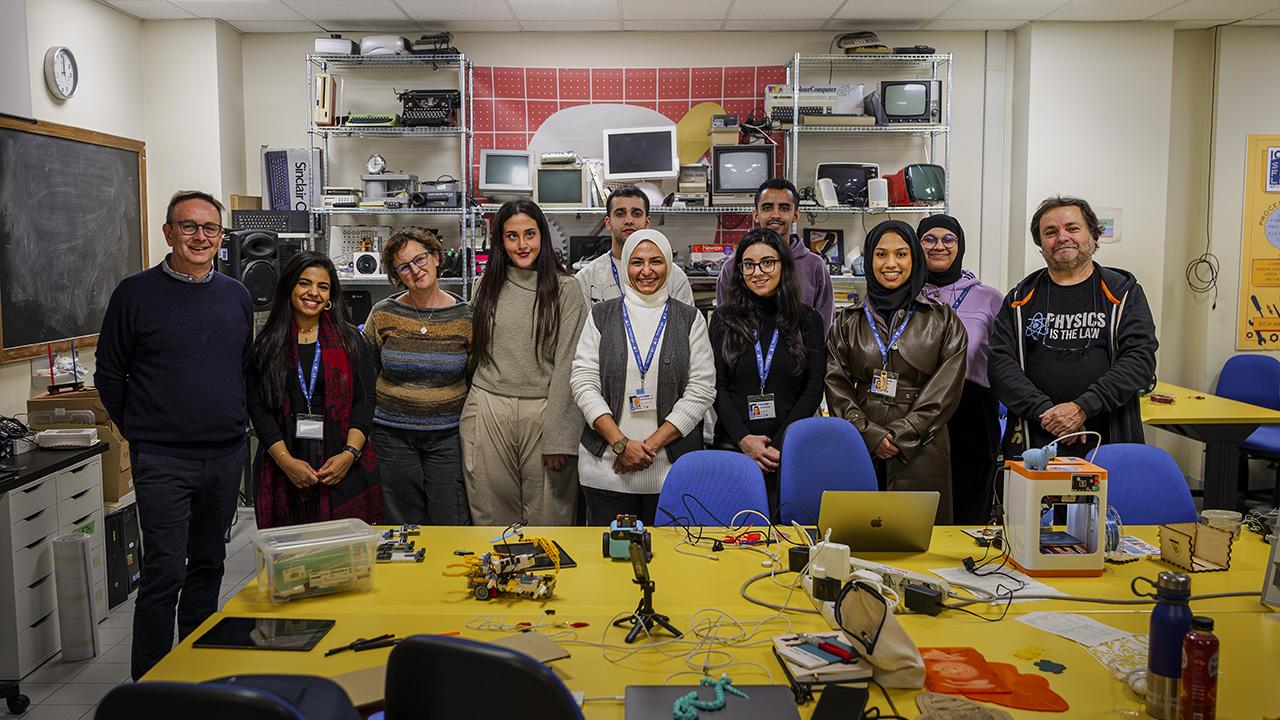
As part of the collaboration between ICTP, KFAS and TSCK, eight people, including science communicators and outreach programme managers working at The Scientific Center of Kuwait, visited ICTP’s FabLab from 24 to 27 November for a four-day training. The event consisted of an introduction to how to manage and operate a FabLab, how to design and produce science outreach activities for different age ranges, hands-on work with digital fabrication tools, and community engagement.
“At TSCK we want to make science, technology, engineering, and mathematics more accessible, and this is exactly what the people here at the SciFabLab have been doing for us this week,” explains Dunia Aldeghaishem, education and programme manager at TSCK. “We learned about 3D printing, 2D and 3D modelling, laser cutting and prototyping machines, as well as robotics,” says Mohammed Merza, a science communicator at TSCK.
The training also aimed to help the Kuwait team develop activities that target children of different ages. “We are showing them various examples based on objects that they could easily reproduce: a cloud chamber to detect cosmic rays, a sandbox that combines basic equipment with both virtual and augmented reality, and some small robots that are very easy to program and can be used even with young kids,” explains Gaia Fior, an assistant project officer at ICTP’s SciFabLab.
At the end of the four days, the teams from The Scientific Center of Kuwait and KFAS also had to define the equipment for their new FabLab, in consultation with the ICTP staff. “I came here expecting a small range of 3D printers, but we were able to try many options—there are so many that comparing them has been a little bit overwhelming, in a good way!,” Merza says. ICTP will then order the equipment needed in establishing the TSCK FabLab.
“This has been the second phase of the new collaboration between ICTP and KFAS,” says Marco Zennaro, head of ICTP’s STI unit. Last August, Fior visited TSCK and the space that will host the new FabLab. She met their teams and got an idea of their needs. A team of people from ICTP will visit TSCK again next April to give a workshop on how to set up and use the new equipment.
The collaboration may go further: based on the FabLab model, the team at TSCK is also considering to organise a large science outreach event in Kuwait inspired by the Maker Faire that ICTP’s SciFabLab organises every year in Trieste. “To help them learn hands-on what a Maker Faire looks like and what it entails, two people from TSCK will come to ICTP next May to attend the event in Trieste,” says Carlo Fonda, head of ICTP’s SciFabLab and Trieste’s Maker Faire main organiser.
Beyond the practical setup, the collaboration is driven by a shared vision for long-term impact. By supporting the development of scientific knowledge and creative skills among young people, ICTP and KFAS hope to create a foundation for a better future. “We are raising new generations that will have to face problems that we don’t know yet, and the best way to prepare them is to provide them with a wide range of skills in science, technology, engineering, maths and art. This is also the best investment we can make,” Aldeghaishem concludes.