


seminars
13
Oct
2026
02
Mar
2027
Earth System Physics
ESP Seminar - Tuesdays 11:00 CET
Hybrid


Back
Recent significant investments in malaria interventions have reduced malaria burden. Contemporaneously, the climate has continued to warm with associated changes in rainfall and weather extremes, which compound year to year and decadal climate variability. Together these impact malaria transmission through the climate sensitivity of the parasite and its mosquito vector. Hence, climate change can either enhance or offset the impact of malaria interventions. Conversely, interventions can be optimised to mitigate the effects of climate, for instance to prevent outbreaks at higher altitudes. Ignoring the confounding effects of climate can result in the impact of interventions being over- or under-estimated. Equally, neglecting the impact of interventions would render attribution of malaria outbreaks to anthropogenic climate inaccurate.
Funded by a major grant from Wellcome, ACCLIMATISE is a three-year project (September 2025 to August 2028) that combines modelling and observations to differentiate the climate signal from that of interventions and other environmental and socioeconomic changes, so that a cost-benefit analysis can fairly assess the efficiency of interventions. We use counterfactual simulations to attribute anthropogenic climate change in malaria trends in endemic settings, as well as extremes in highland areas and the monsoon fringe with a range of intervention scenarios. An AI-emulator will be co-designed with stakeholders to assess efficient intervention strategies in the present and near future to 2050.
ACCLIMATISE addresses the UN Sustainable Development Goals 3 and 17.
Stakeholders: Beneficiaries and Partners
| Country | Partners |
| Senegal | Université Gaston Berger de Saint-Louis (UGB), Université Cheikh Anta Diop de Dakar (UCAD), Institut Pasteur de Dakar (IPD), Ministry of Health, Programme National de Lutte contre le Paludisme (PNLP) |
| Kenya | Kenya Medical Research Institute (KEMRI), Ministry of Health (National Malaria Control Programme Kenya) |
| Italy | ICTP (Coordinator), University of Trento |
| Switzerland | Swiss Tropical and Public Health Institute (Swiss TPH) |
| USA | New York University (NYU) |
| Ethiopia | Addis Ababa University (AAU), Ethiopian Public Health Institute (EPHI), Ministry of Health |
Planned Activities and Key Deliverables
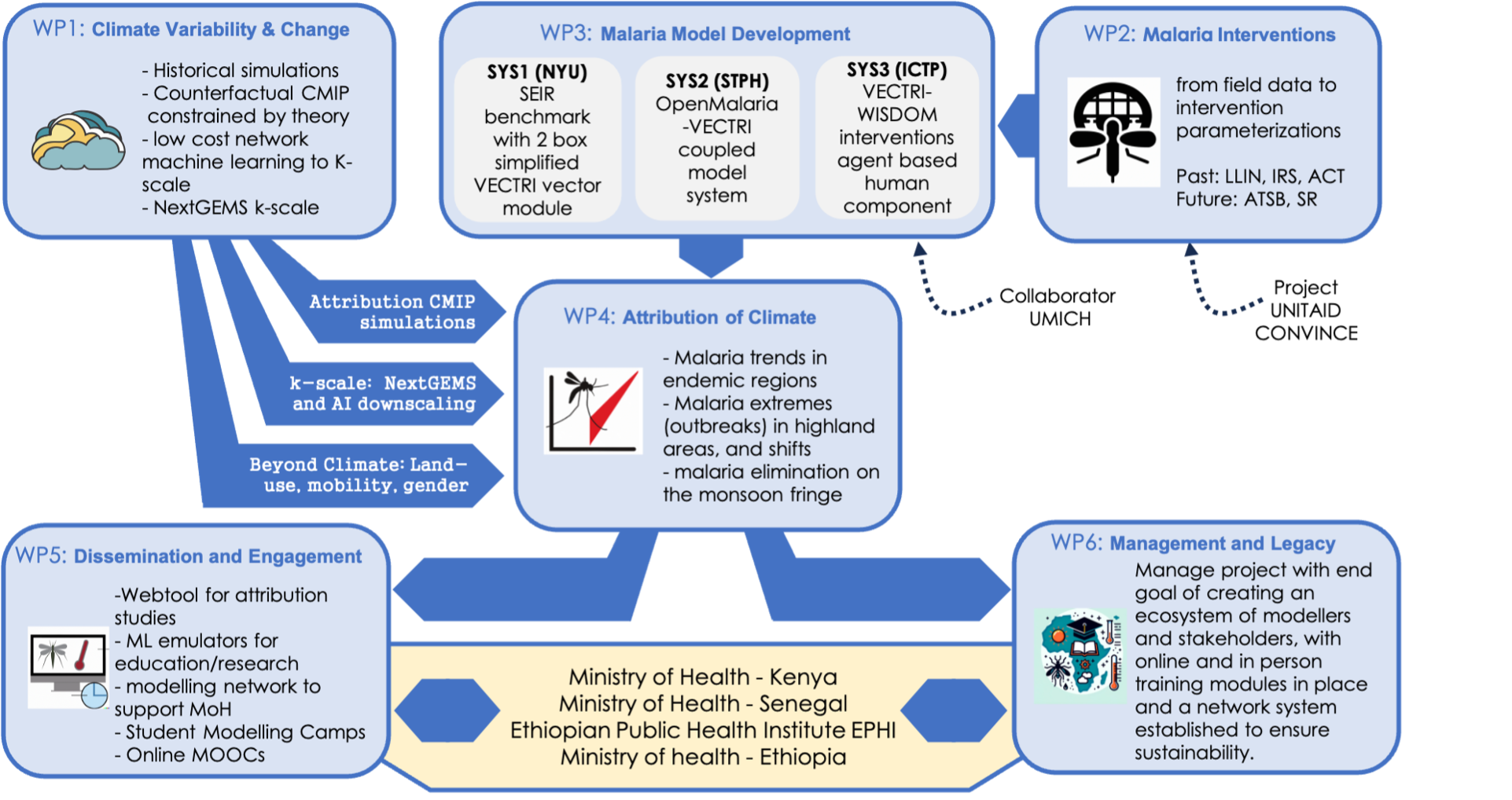
Activities are divided into 6 work packages (Figure) with the consortium contributions (leads are bold) in each WP, task (T) and deliverable (D) given along with the month (M). Asterix-marked T1-4, T3-4, T4-4, T5-4 on AI downscaling, mobility & machine learning for decision support are considered “blueskies” extensions; high ambition-high risk, but not essential for the project success.
ICTP Contact
Adrian Tompkins, Senior Research Scientist, Earth System Physics section
tompkins@ictp.it
+39 040 2240 579